

I spent years sleeping on a generic air mattress at state park campgrounds, and I spent years waking up at 5 in the morning on the floor of the tent with my back complaining. The mattress and I parted ways in February. It had a slow leak I could never find, so it went flat overnight and left me on the tent floor by morning. I replaced it with a Therm-a-Rest Z Lite Sol in the first week of March, and I have slept on it on every camping weekend since, roughly ten trips from March to October.
So this is not a theory list. It is a list from eight months of real weekends, in a four-person tent, on gravel campsite pads, with a stiff lower back that does not appreciate being lied to. If you are still fighting an air mattress and wondering whether a foam pad is worth the change, these are the ten things I noticed.
The pad I stopped fighting with at 5 in the morning
Closed-cell foam, 72 inches long and 20 wide, 0.75 inches thick, and it folds up instead of deflating. See today's price and the size options on Amazon.
Amazon Check Today's Price on Amazon →It cannot spring a leak, because there is nothing to inflate
An air mattress is a sealed bag of air held together by seams. Every seam is a place to fail. The Therm-a-Rest Z Lite Sol is a closed-cell foam pad with no valve, no chamber and no pump, so there is no night where you wake up on the ground and no morning spent hunting for the leak with a soapy sponge. I did that sponge routine twice with the old mattress and never found the hole either time. After eight months of weekends, the foam pad has not given me one bad night from gear failure.
Setup takes about four seconds, in the dark
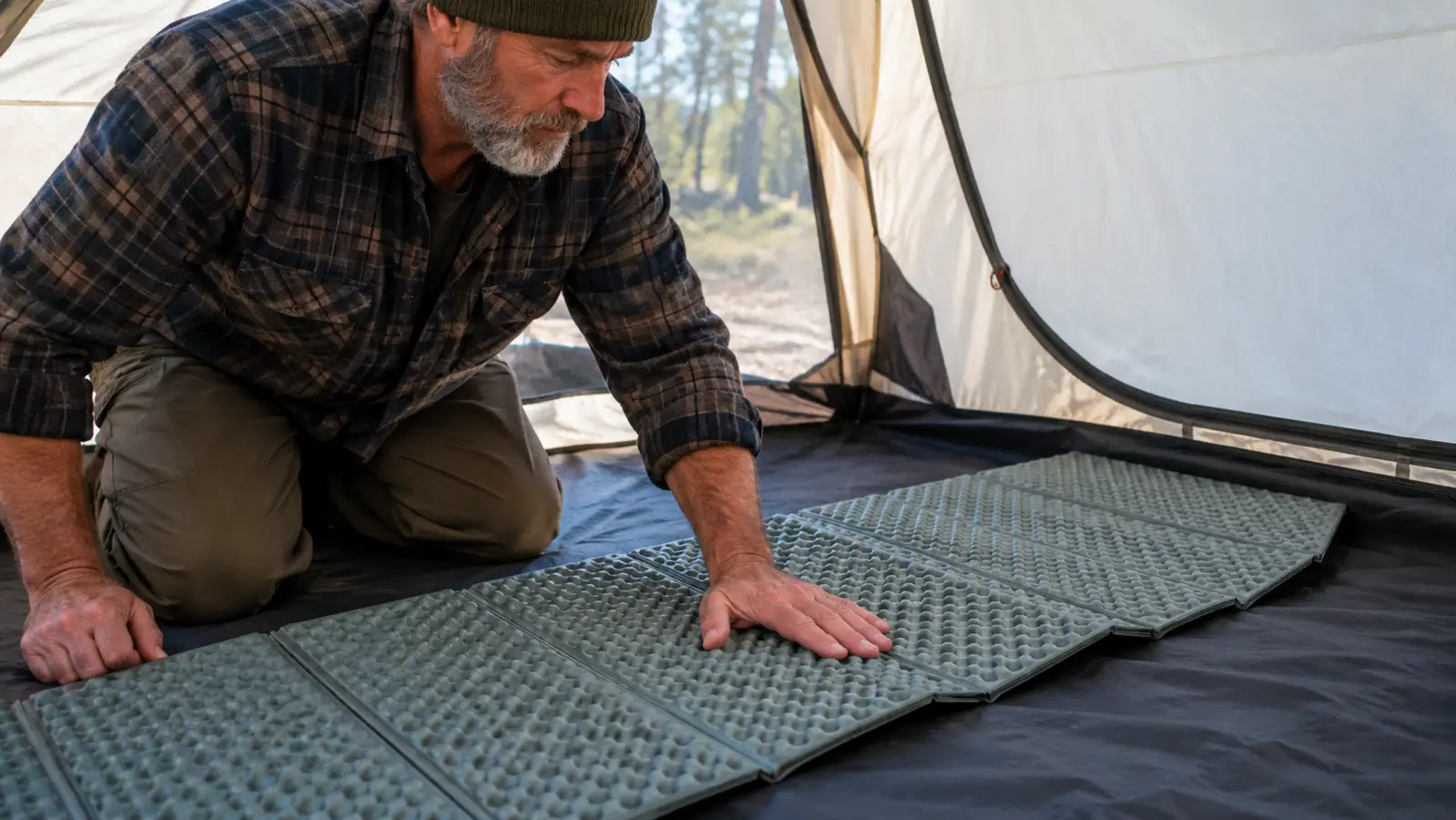
We pull into a campground after dark more often than I would like to admit. With the air mattress, that meant unrolling it, finding the pump, plugging the pump in or pumping by hand for several minutes, and hoping I had not lost the valve cap. With the foam pad, I unroll it on the tent floor and I am done. No pump to pack, no batteries, no hose, no valve. That is the whole setup. On a wet arrival it does not matter, because there is nothing to get water into.
It is firm, and firm turned out to be the point
I want to be honest here, because other people's reviews were not. This pad is thin at 0.75 inches and it is firm. It is not the pillow-top mattress experience. What I found is that firm support is what my back wanted, and I woke less stiff within the first two weekends on it. Ray still sleeps on his own generic pad and has no complaints either way. If you want to sink into something soft, the Z Lite Sol is the wrong pad for you and I will say so again later in this list.
It survives being thrown in the back of a car
My air mattress lived in fear of the car. A sharp corner, a camp chair leg, a cooler lid closing on a corner, and it was done. Closed-cell foam does not care. I fold this Therm-a-Rest pad, stack it with the tent and the duffel, and it goes in the back of the CR-V. Eight months of packing and unpacking and there is not a puncture, not a tear, not a scuff that matters. The listing calls it water resistant, and I can tell you it does not soak up dew or a damp tent floor.
It folds flat instead of fighting back into a bag
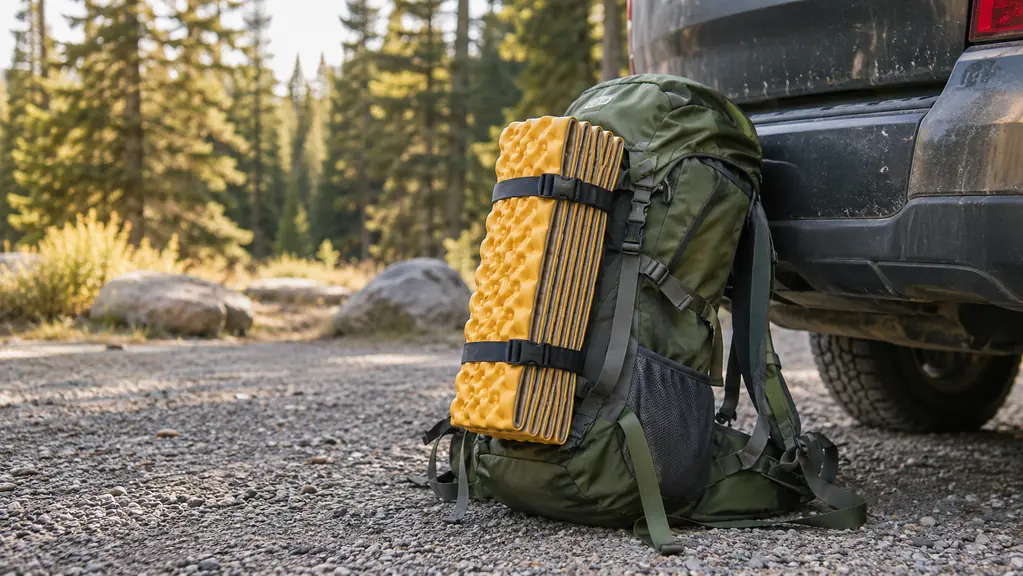
Anyone who has wrestled a queen air mattress back into its carry bag at 7 in the morning knows the particular rage of that job. The Z Lite Sol folds accordion style into a compact block, 20 by 5 by 5.5 inches per the listing, and it straps or stuffs without a fight. It weighs 14 ounces, so I barely notice it in the load. That also makes it the pad I would grab if I ever started walking in to a site instead of parking next to one.
The dimples and the coating actually hold some warmth
I am not going to give you a temperature rating, because I do not have one I trust and the listing does not promise me a number. What I can tell you is that the pad has a reflective ThermaCapture coating and heat-trapping dimples, and the manufacturer says that combination increases warmth by about 20 percent. On a cold October weekend in the foothills, I was warm enough in my bag, and I did not have the cold-from-below feeling I used to get. Treat that as my experience, not a spec.
It does not move around under you all night
The air mattress slid. It slid on the tent floor and it slid under me, and I would wake up half off it. The foam has a texture that grips the tent floor, and it stays where I put it. The dimples help there too. I roll over a few times a night with a stiff back and the pad has never ended the night somewhere other than where it started. Small thing, big difference over ten weekends.
Two people can share a tent again without one of them bouncing
An air mattress is a trampoline. Every time Ray rolled over, I felt it, and every time I got up to walk the 200 yards to the bathhouse, the whole mattress moved. With two separate foam pads side by side on the tent floor, his moving around is his business and mine is mine. We sleep in the tent together, two people and our bags, and we no longer wake each other up. I did not expect that to matter as much as it does.
Nothing to patch, nothing to replace, no maintenance at all
Twenty-five years of camping has taught me that gear with fewer parts lasts longer. The air mattress had a patch kit, a pump, a valve cap and a storage bag, and the pump was the first thing to go. The Therm-a-Rest foam pad has none of that. There is no valve to lose and no pump to fail. I wipe it down, I let it air out, I fold it, and it goes back in the car. That is the entire care routine, and it has not changed in eight months.
It doubles as a seat when the ground is cold and wet
This is the use I did not plan for. On a damp morning in May, after the all-night rain we had that weekend, the picnic table bench was soaked. I folded the pad twice and sat on it. Later that same trip I used it as a kneeling pad while I dug through the duffel. An air mattress cannot do any of that without a pump and a risk of punctures. A foam pad is a piece of gear that keeps earning its space in the car.
What I'd Skip
If you are a side sleeper who needs cushion, or you are used to a thick inflatable pad with a lot of loft, this is not your pad. It is 0.75 inches of firm closed-cell foam, and I will not pretend otherwise. If you want a pad you can deflate and roll tight into a small stuff sack, foam folds into a block instead and it takes up more room in the car than an inflatable does. If you are mostly backpacking and counting ounces down to the last one, look at the inflatable options first. The Therm-a-Rest Z Lite Sol suited me because I am a car camper with a stiff back, a Honda CR-V to put it in, and no patience left for pumps and leaks. That is the whole case.
I spent years waking up on the tent floor at 5 in the morning. Eight months on a 0.75-inch foam pad and it has not happened once.
Eight months, ten weekends, zero mornings on the tent floor
Closed-cell foam, no valve, no pump, no leak. Folds to 20 by 5 by 5.5 inches and weighs 14 ounces. See today's price on Amazon.
Amazon Check Today's Price on Amazon →