
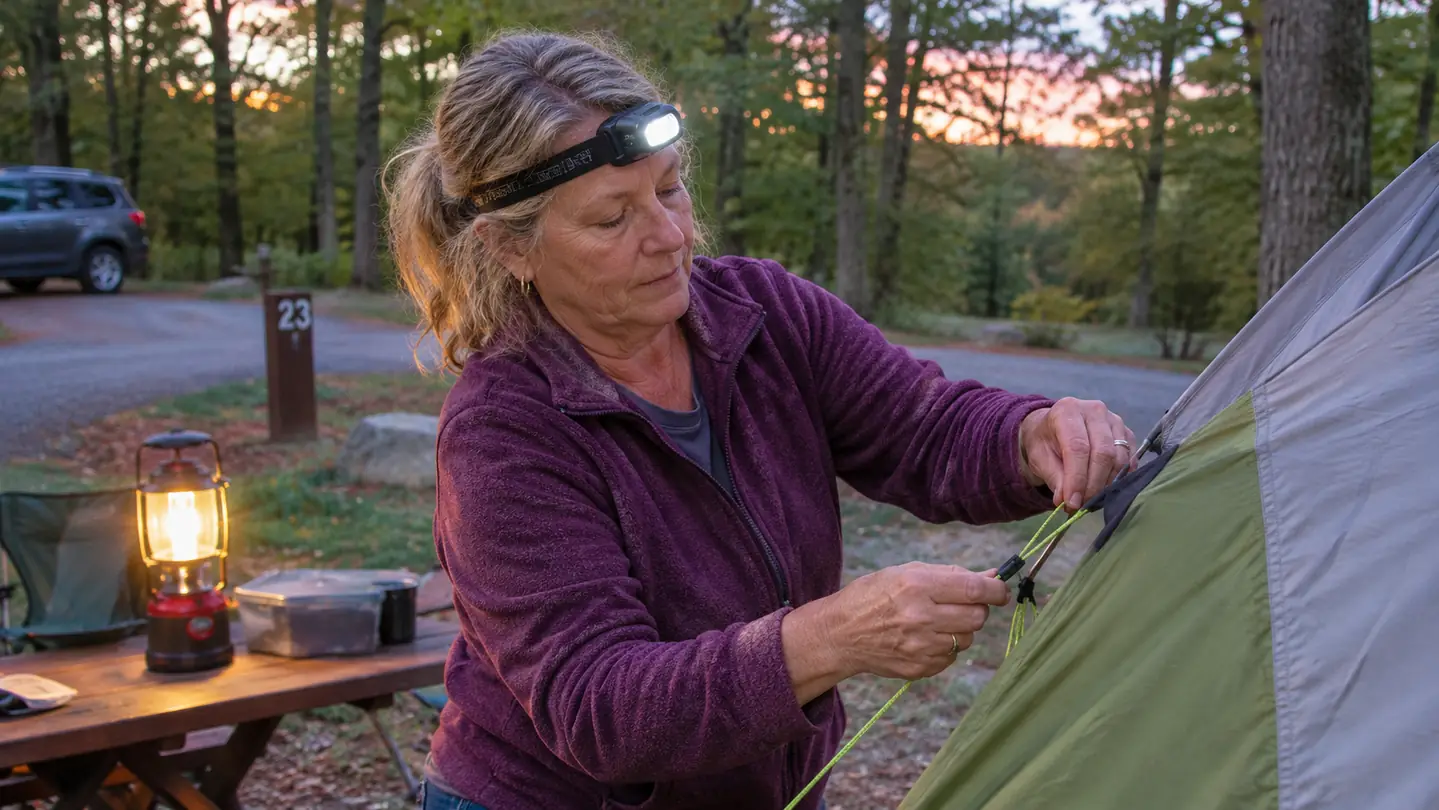
The first time I walked the 200 yards from our campsite to the bathhouse in the dark, I held a handheld flashlight in my teeth. That was March, our first weekend out with the Black Diamond Spot 400, and I had already spent twenty-five years camping the southern Appalachian foothills. I am 57, a retired dental hygienist from outside Fort Payne, Alabama, and I am not a gear reviewer. I am a woman who wants to find the bathhouse door without dropping a towel in the gravel. The headlamp did that on the first night, and it has done it on every camping weekend since.
A headlamp is not complicated. It is a light that sits on your head and leaves both hands free. Ray, my husband, has his own light, and I have mine. We are not backpackers. We car camp at state park campgrounds with a bathhouse, and I day hike three to six miles most weeks from March to October. The headlamp is camp gear for me, not a hiking tool after sundown. That is exactly why it earns a place in the tent pocket.
The light I reach for every night after the sun drops
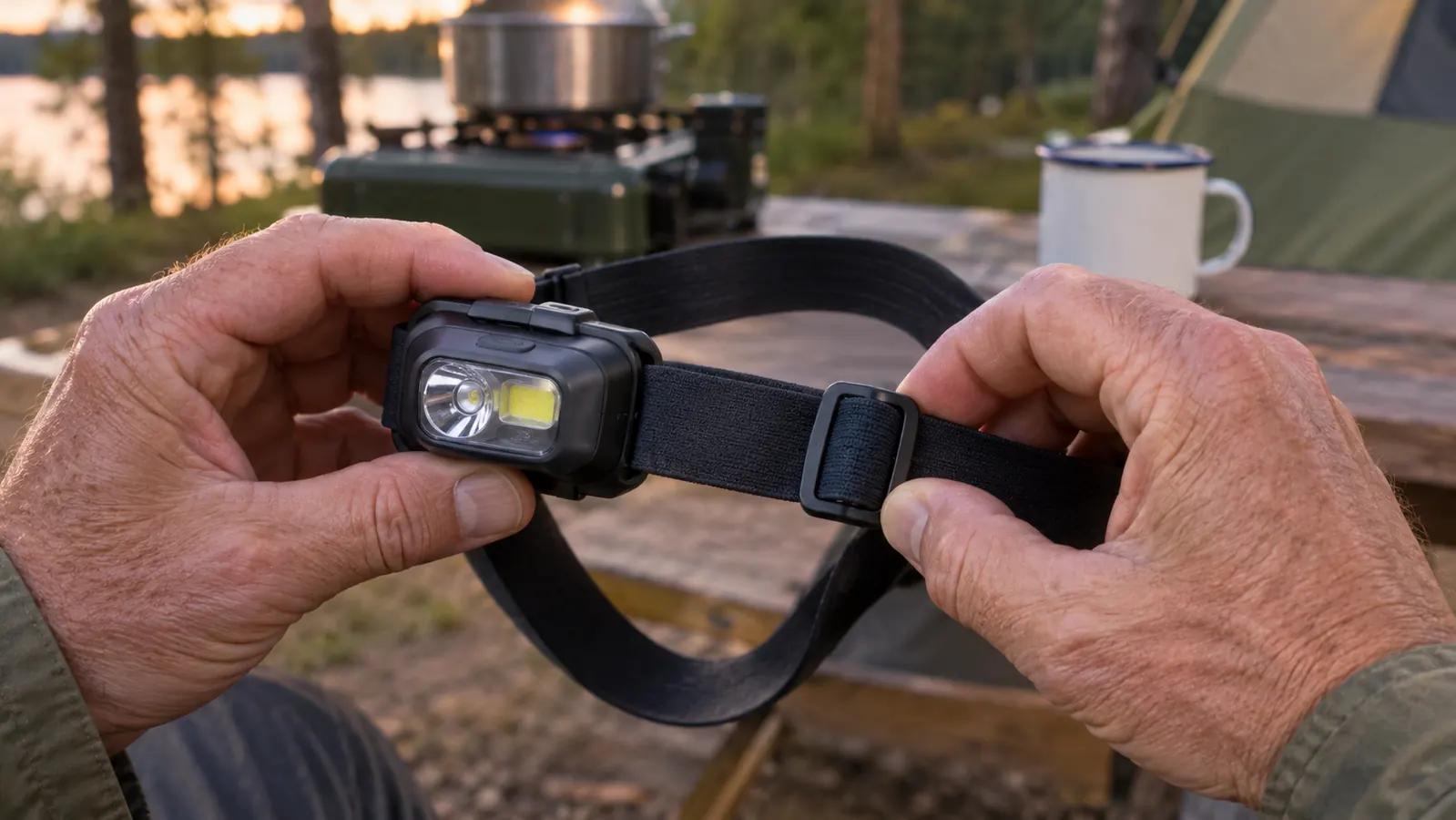
The Black Diamond Spot 400 puts 400 lumens on the path ahead, with multiple brightness settings and proximity modes for close work like zippers and stove knobs. The red night-vision mode is the one I use inside the tent so I do not wake Ray. It runs on three AAA batteries, which are included, and it can be upgraded with the BD 1500 Li-ion battery and charger sold separately.
Amazon Check Today's Price on Amazon →It keeps both hands free on the gravel loop
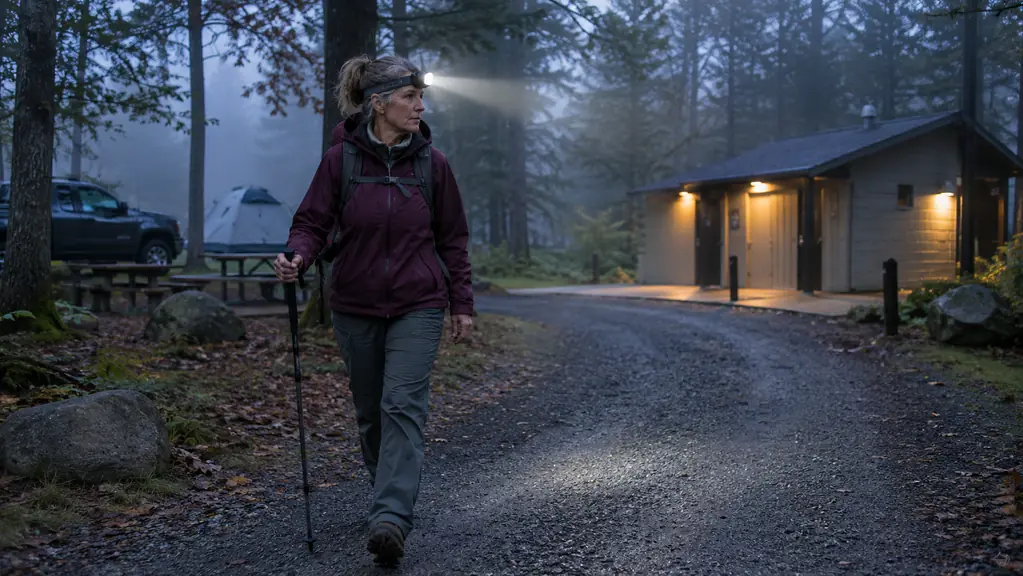
Our usual site is about 200 yards from the bathhouse, along a gravel loop road. In the dark, that walk is not hard, but it is full of small jobs: carry the towel bag, open the door, hold the rail, keep your balance. A handheld flashlight turns those jobs into a juggling act. I held one in my teeth more than once. With the Black Diamond Spot 400 on my head, both hands stay free. The adjustable headband holds it secure, and I can look at the path instead of pointing a light at it.
It puts light on the skillet, not on your forearm
I cook after dark on most camping weekends. Ray and I run the Camp Chef Explorer 2-Burner beside the car, and I like to have coffee going on one burner and potatoes in the cast iron on the other. A handheld light is useless for that. You either set it down and light your own elbow, or you hold it and stir one-handed. The headlamp aims where I look. I can see the edge of the skillet, the spatula, and the flame without asking Ray to stand there and hold a light.
The red mode keeps the tent quiet at 2 a.m.
The Spot 400 has a red night-vision mode, and that is the setting I use inside the tent. If I need to find my glasses or unzip the door in the middle of the night, I do not want a white blast of light waking Ray. The red mode gives me enough to see the zipper pull and the floor of the tent without turning the whole campsite into a movie set. It is a small thing. It makes a shared tent feel less like a shared flashbulb.
400 lumens is enough without being a nuisance
The listing says 400 lumens, and I believe it. On the walk to the bathhouse, I use a lower setting and let the light pool a few feet ahead. On full power, it reaches farther than I need at a state park campground. The multiple brightness settings and proximity modes let me go from a broad look down the road to a close look at a tent zipper. I do not need to light the whole loop. I need to see my own feet and the next ten steps.
Three AAA batteries, changed once since March
The Spot 400 runs on three AAA batteries, and they are included. I bought the headlamp in the first week of March and changed the batteries once, in August. That is with use on about ten camping weekends, plus the nightly bathhouse walk and dinner cleanup. I keep a spare set in the glovebox, but I have not needed them yet. If you prefer, the light can be upgraded with the BD 1500 Li-ion battery and charger, which is sold separately. I have not made that switch.
It handles a damp walk back from the bathhouse
The headlamp is waterproof, and I have worn it on the wet walk back from the bathhouse that May. I am not swimming with it. I am walking a gravel road in the rain with a towel bag over one shoulder, and I need the light to keep working. It has. The polycarbonate body has picked up a few scuffs in the tent pocket, but the light still comes on every time. That is the kind of reliability I want from camp gear.
It fits over a cap and does not slide down
I wear a ball cap on sunny days, and I have worn the headlamp over the brim when the light starts to go. The adjustable headband opens wide enough to fit over the cap, then tightens down. At 3.04 ounces, it does not pull at my forehead or slide down when I look at the ground. The compact design means it packs into a tent pocket without taking up the space of a lantern. I have a small head, and it still adjusts down far enough.
It retires the handheld flashlight to the glovebox
My old handheld flashlight still lives in the Honda CR-V glovebox. It is fine for checking something under the hood or reading a paper map. It is not fine for camp after dark. The first night I used the headlamp, I realized I had been making the bathhouse walk harder than it needed to be. The flashlight was not a bad tool. It was the wrong tool for a job that needed two hands. The Black Diamond Spot 400 is the right tool for that job.
It makes a middle-of-the-night tent exit less of a production
I am 57, and I have a stiff lower back in the mornings. That is not a diagnosis, just a fact. When I get up in the night, I want the exit to be simple. The headlamp sits by my sleeping pad. I put it on, switch to red, find my shoes, and unzip the door. I am not sweeping a flashlight beam around the tent and waking Ray while I look for the zipper. The whole thing takes less time, and I go back to sleep faster.
It is one small piece of gear that earns its pocket
The Spot 400 is 1 inch deep, 1 inch wide, and 2 inches high, according to the listing. That is small enough to live in the tent pocket beside my glasses. I do not have to dig for it in the dark. I do not have to ask Ray where he put the flashlight. It is there, and it works. For a car camper who makes the same bathhouse walk every weekend, that small certainty is worth more than a drawer full of gadgets.
What I'd Skip
I would skip the idea that a headlamp replaces a camp lantern. It does not light a picnic table for four or make a tent feel like a living room. I would also skip wearing it on daytime hikes. I tried that once and felt silly with a light on my forehead at noon. For me, the Spot 400 is a camp-after-dark tool: the bathhouse walk, the dinner cleanup, the 2 a.m. zipper. If you need a big light for a group, pack a lantern too. The Black Diamond Spot 400 is the light you wear, not the light you set on the table.
I walked that 200-yard gravel loop every night for a season, and I never once put a flashlight in my teeth again.
The light that stays in the tent pocket
If you want a hands-free light for the bathhouse walk, the late dinner cleanup, and the middle-of-the-night zipper, the Black Diamond Spot 400 is the one I bought in March and used through one season. Three AAA batteries are included, and the red mode is there when you need it.
Amazon Check Today's Price on Amazon →