

I bought the Black Diamond Spot 400 in the first week of March and wore it through one full season, March to October, on about ten two-night campouts and most of my weekly day hikes. My husband, Ray, and I camp at state parks in north Alabama. The walk from our usual site to the bathhouse is about 200 yards on a gravel loop road, and that walk is where a headlamp earns its keep. I have never owned the Petzl Tikka. I handled one in a store in Fort Payne and looked at a neighbor's at the campground, and I compared what I could see and read. Short answer: the Black Diamond Spot 400 is the better lamp for my kind of camping, but the Tikka is the one I would hand to someone who wants to forget the lamp is on their head.
The differences are not dramatic. Both are small battery headlamps that strap to your head and put light where you look. The Spot 400 is rated at 400 lumens, has several brightness settings and proximity modes, and is listed as waterproof. It runs on three AAA batteries, which came in the box, and it can be upgraded with the rechargeable BD 1500 battery and charger, sold separately. The Tikka is lighter and simpler, with one button and a wide beam. If you cook after dark, walk to a bathhouse, and want a red mode so you do not wake your partner, the Spot 400 is the safer pick. If you want a light you barely feel and you mostly read or sort gear inside a tent, the Tikka makes a strong case.
| Black Diamond Spot 400 | Petzl Tikka | |
|---|---|---|
| Top brightness | Rated 400 lumens. | Published top output is lower than 400 lumens, and the store demo was dimmer at the top end. |
| Beam control | Several brightness settings plus proximity modes for close work. | One wide beam, adjusted by brightness level. |
| Water resistance | Listed as waterproof. | Petzl rates the Tikka as weather resistant, which is a lower claim. |
| Weight | 3.04 ounces with batteries. | Felt lighter in my hand than the Spot 400. |
| Simplicity | More modes means more clicks to learn. | One button, and I had it figured out in the store aisle. |
| Red mode | Red night-vision mode. | Red setting on the model I handled. |
| Power | Three AAA batteries included; rechargeable BD 1500 sold separately. | Three AAA batteries; the clerk said a rechargeable battery is sold separately. |
| Fit | Adjustable headband. | Adjustable elastic band. |
| Best for | Cooking, camp chores, and the bathhouse walk when you want a bright beam and a red mode. | A light you barely notice on your head for reading and sorting gear. |
How I Compared Them
I did not run a lab test. I wore the Spot 400 for eight months on real weekends, and I paid attention to the things that annoy me at camp: a beam that is too narrow, a button I cannot find with cold fingers, and a lamp that quits in the rain. I changed the three AAA batteries once, in August, and I used the red mode on every late trip to the bathhouse. That is the whole test. It is not a laboratory, but it is the kind of use most weekend campers will give a lamp.
The Tikka side is thinner. I have never owned one. I handled a display model in a store in Fort Payne, and I looked at a neighbor's Tikka at the campground one evening when we were both walking back from the bathhouse. I also read the published specs. I am judging it the way you would judge a lamp at a campground: pick it up, put it on, click the button, and ask what it would do on the 200-yard walk. The store trip was a Tuesday afternoon in April, and I stood in that aisle a good fifteen minutes, clicking the display lamp on and off, tightening the band, and reading the back of the package twice. The clerk came by once and I told her I was only comparing. The neighbor's lamp I held for maybe two minutes, standing on the gravel with wet hair, and he told me he had used his two seasons without a complaint. Two minutes and a stranger's opinion is not a test, and I will not pretend it is.
I compared them on brightness, beam control, water resistance, weight, simplicity, red mode, power, fit, and the job each one does best. Those are the things that decide whether a lamp stays on your head or ends up in the glovebox. The Spot 400 won most of them. The Tikka won two that matter more than people admit.
I also paid attention to fit. Both lamps have adjustable bands. The Spot 400 has a polycarbonate body, and the headband held its position on my head over a baseball cap. The Tikka's elastic band felt fine in the store. I cannot tell you how either one does on a hat for six hours, because I did not wear the Tikka that long. That is an honest limit.
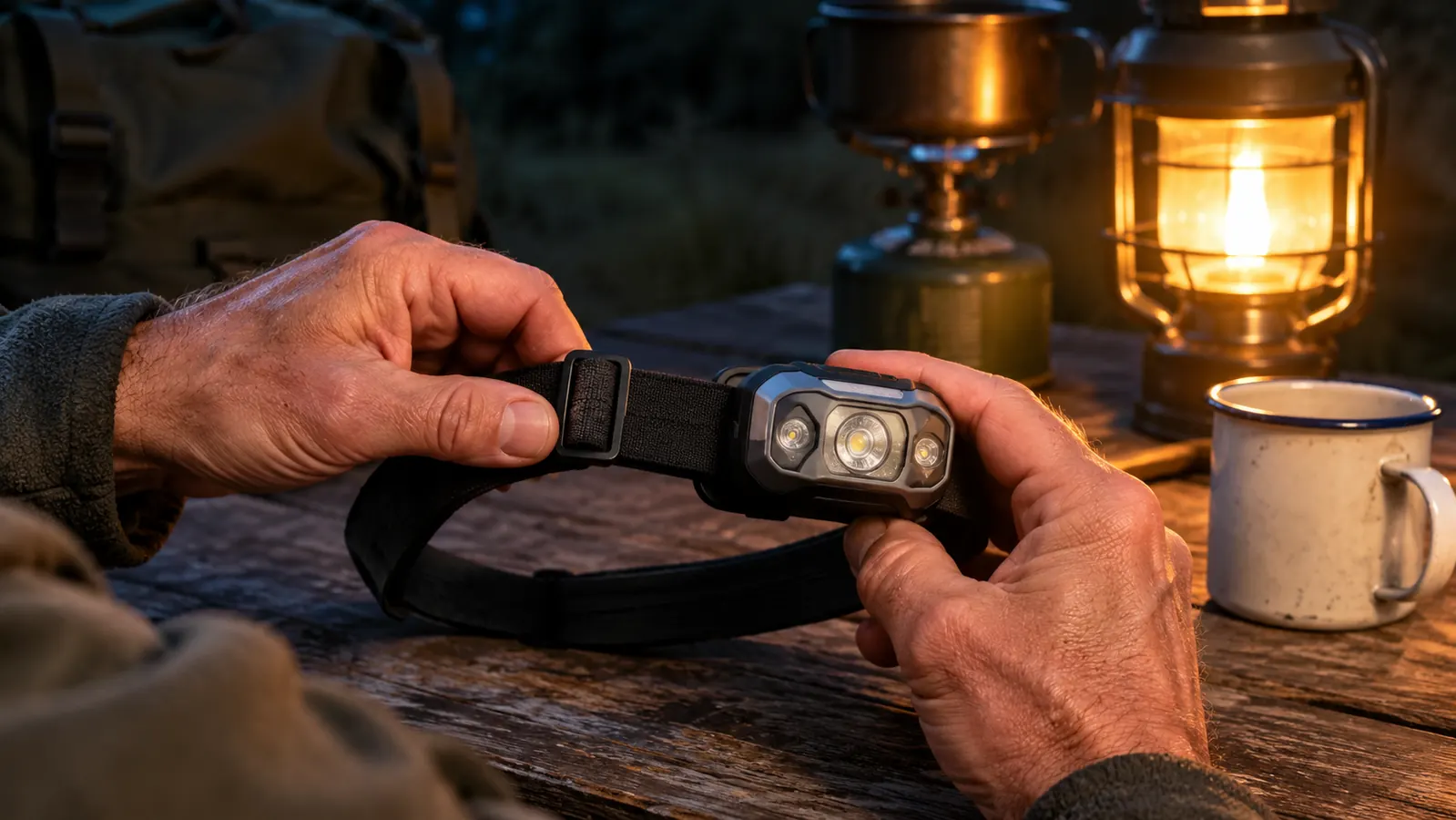
Where Black Diamond Spot 400 Wins
The first thing is light. The Spot 400 is rated at 400 lumens, and it has several brightness settings plus proximity modes. That means I can light the whole picnic table, the camp stove, and the path to the water spigot without turning my head into a searchlight. When I am spooning coffee into a mug before daylight, I click down to a softer setting and the light stays where I need it. The Tikka's published top output is lower, and the store demo was dimmer at the top end. In real camp use, that gap shows up when I am trying to see beyond the table.
The second is the waterproof rating. The Spot 400 is listed as waterproof. The Tikka is rated weather resistant by Petzl, which is a lower claim. One wet weekend in May is what settled it for me. It rained hard all night at the campground, and I made the walk to the bathhouse in it with the Spot 400 on my head. It never flickered or dimmed. Back at the tent I blotted the band with a towel and hung it up to dry, and that was the entire repair. Nothing else to report, which is the report I want from a lamp. I am not going to tell you to dunk it, because I have not. But I do not worry about it in a downpour, and that is worth something when the bathhouse is 200 yards away and the sky has opened up.
The third is the red mode. At 2 a.m., the red mode is enough to find my shoes and the door latch without turning Ray into a grumpy silhouette. I wear it on the gravel loop and I do not have to hold a handheld flashlight in my teeth. That sounds small until you have done it the other way for years. The Spot 400 also runs on three AAA batteries, which came in the box, and it can take the rechargeable BD 1500 battery and charger later if you want to buy that separately. I have not bought it. The AAA batteries have been fine.
One more thing: the Spot 400 has been consistent. It has not flickered on the gravel loop, and it has not cut out when I bumped it against the tent pole. I changed the batteries once in August, and that was it. A headlamp earns trust by being boring, and this one has been boring in the best way.
The red mode is the reason I stopped carrying a handheld flashlight to the bathhouse.
Where Petzl Tikka Wins
The Tikka is lighter. I do not have a kitchen scale number for it, but in my hand it felt lighter than the Spot 400, which is listed at 3.04 ounces with batteries. The Spot 400 measures about 1 inch deep by 1 inch wide by 2 inches tall, and it rides forward on the forehead. By the end of an evening I notice it there, the way you notice a watch. I did not notice the Tikka in the aisle at all, and the neighbor said he forgets his is on. That is his word, not mine, but it matches what my hand told me. On a head, the difference is small. At the end of a long day, small is still small, and a lighter lamp is easier to forget you are wearing. If you only put a lamp on for twenty minutes at night, this will not matter. If you wear one for hours, it might.
The second is simplicity. The Tikka has one button. I picked it up in the store and had it on in about four seconds. The Spot 400 asks you to learn its clicks. I know them now, but I did not know them in March, and I have clicked past the setting I wanted more than once. If you are the person who wants a lamp that works the same way every time, the Tikka is the easier lamp to live with.
The third is the beam shape. The Tikka's wide beam is even and pleasant for close work. Reading a map, sorting a food bag, finding the zipper on a tent. The Spot 400 can do that too with a proximity mode, but you have to remember the sequence. On the Tikka, the light is already shaped for it. That is a real advantage for a lamp that lives in a tent pocket.
I will also say this for the Tikka: it does not pretend to be a spotlight. It is a camp lamp, and it is honest about that. If your expectations match, you will be happy with it. If you buy it expecting to light the far end of a parking lot, you will be disappointed, and that is not the lamp's fault.
If the 200-yard walk to the bathhouse is your main reason for a headlamp, this is the one I would buy again
The Black Diamond Spot 400 gives you 400 lumens, proximity modes, a red night mode, and a waterproof rating in a 3.04-ounce lamp. It runs on three AAA batteries and can take the rechargeable BD 1500 later if you want it.
Amazon Check the Black Diamond Spot 400 on Amazon →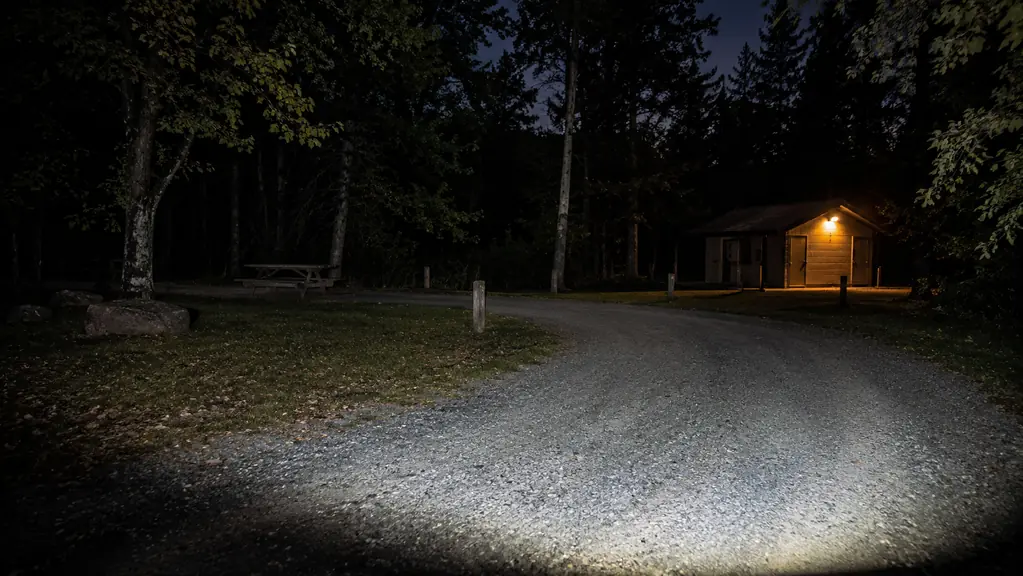
What Neither Lamp Will Fix
Neither lamp will fix a dead battery. Neither will make a dark campground road shorter. A lamp is not a lantern. If you want to light a whole campsite for two people, neither of these will do it. They are for the job in front of your face.
And neither one will make you remember to pack spare batteries. That is on you, and on me. I keep three spares in the glovebox now because I got tired of learning the same lesson. A good headlamp is a tool, not a guarantee. You still have to put it on your head and point it at the thing you want to see.
Who Should Buy Which
Buy the Black Diamond Spot 400 if you want the brightest beam of the two, a red mode for late-night camp chores, a waterproof rating, and proximity modes for close work. Buy it if you camp with a partner who goes to bed before you, because the red mode alone is worth the trade. Buy it if you do not mind a 3.04-ounce lamp and a few minutes of learning the button. That is my case. I would buy it again.
Buy the Petzl Tikka if you want a light you barely feel, one button, and a wide beam that is ready for close work without a sequence to remember. Buy it if your lamp mostly stays inside the tent and you do not need a waterproof claim. It is a fine lamp. It is just not the lamp I would choose for the gravel loop at 2 a.m. with rain coming on.
Think about where the lamp actually lives. Mine hangs on a hook by the tent door and comes off four or five times in an evening, between the stove, the cooler, and the walk to the bathhouse. If yours sits in a duffel pocket and comes out once at bedtime, most of that extra brightness is wasted on you, and the lighter lamp is the smarter buy.
If you are still on the fence, ask yourself one question: what is the lamp for? If it is for the walk to the bathhouse, the cooking after dark, and the middle-of-the-night trip you do not want to talk about in the morning, get the Spot 400. If it is for reading in your sleeping bag until you get sleepy, the Tikka is plenty.
One season in, I would buy the Black Diamond Spot 400 again
It has done every job I ask of a camp headlamp: cooking after dark, the bathhouse walk, and a red mode that keeps the peace in a small tent. If your camping looks like mine, start here.
Amazon See the Black Diamond Spot 400 on Amazon →