
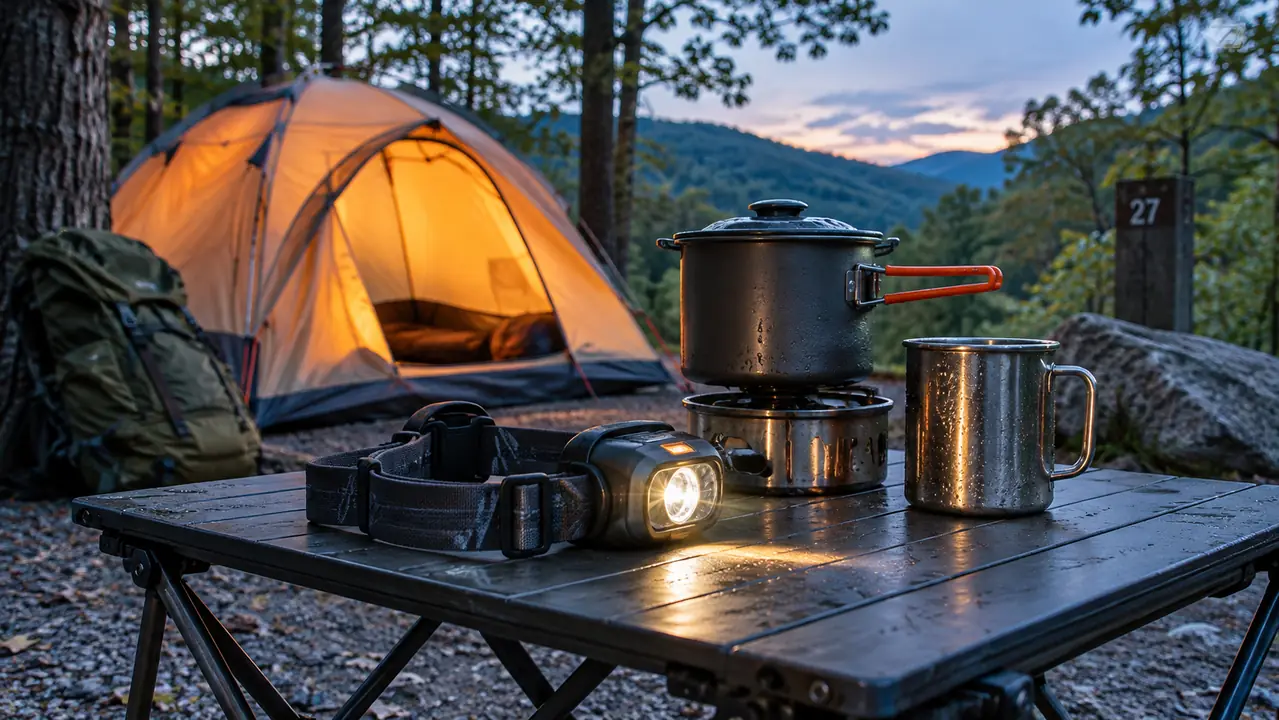
I bought a headlamp for one reason. I was tired of holding a flashlight in my teeth while I dug a toothbrush out of a toiletry bag. Our usual campsite sits about 200 yards from the bathhouse, down a gravel loop road, and by the time I have walked that road after dark and walked it back, I have needed both hands at least six times. The flashlight was the wrong tool from the start. It rolled off the picnic table. It pointed at my shoes when I wanted it pointed at the path. So in the first week of March I bought a Black Diamond Spot 400, and it has been on my head on every camping weekend since.
That is one season. March through October, about ten two-night weekends at state park campgrounds in north Alabama, every one of them with a bathhouse and a gravel loop. I am not a backpacker and I do not pretend to be one. I day hike three to six miles most weeks and I car camp with my husband, Ray. So this is not a review written from a gear closet after two hours in the driveway. It is what one headlamp did on real weekends, including the parts that got on my nerves.
The Quick Verdict
The Spot 400 does the two jobs I actually need after dark, walking the bathhouse road and cooking at the stove, and it does them without me thinking about it. The red mode is the reason I stopped missing a handheld flashlight. It is not the light I would choose if I still hiked after sundown.
Amazon Check Today's Price →The headlamp I reached for every night for eight months
400 lumens, a red night-vision mode, and three AAA batteries in the box. Ten camping weekends on the original set, with one change in August.
Amazon Check Today's Price on Amazon →How I've Used It
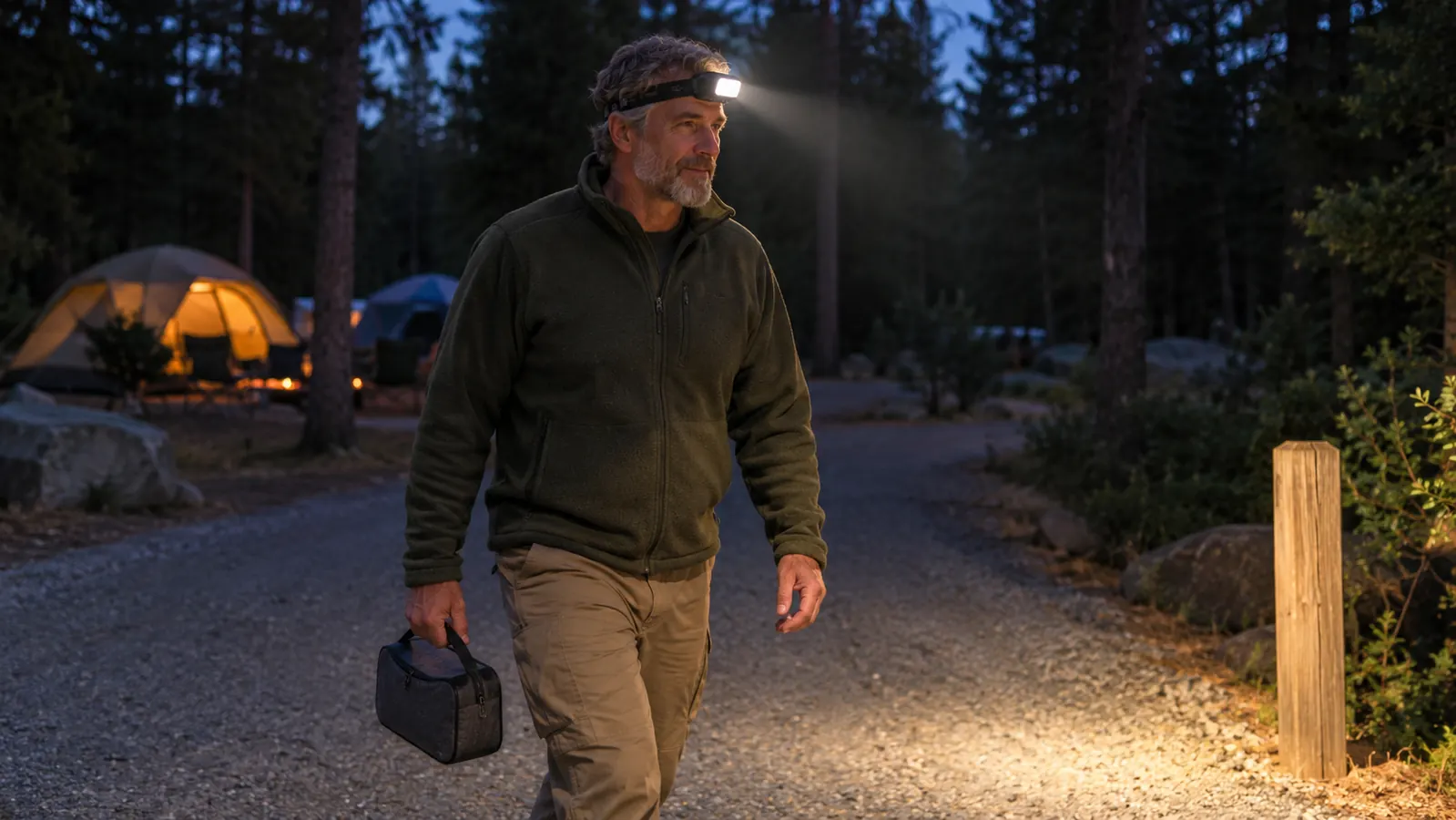
Almost all of my use happens in two places. The first is that gravel loop between our site and the bathhouse. I put the Black Diamond on before I leave the picnic table, click it to full brightness, and walk. My hands stay free for a toiletry bag, a towel, and the gate latch at the end of the loop, which is a small thing that turns out to matter more than I expected. On the way out I want the whole road lit. On the way back, usually after ten, I dim it down so I am not throwing a beam into somebody else's tent screen.
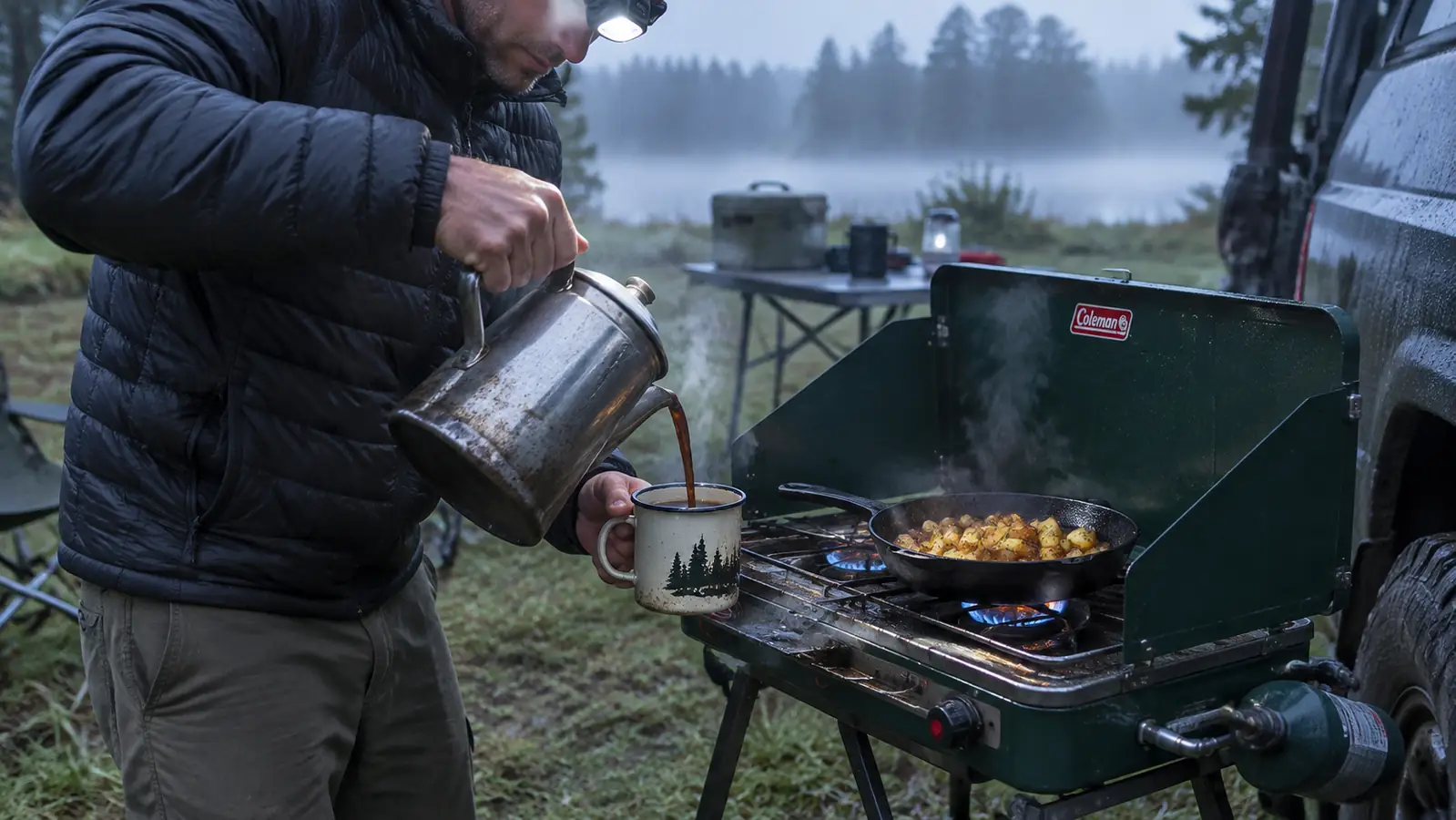
The second place is the stove. We cook outside on every camping weekend, and from about mid-September on, breakfast starts before the sky is any use. Ray unloads the car while I get the Camp Chef Explorer 2-Burner set up on its legs beside the CR-V, coffee going on one burner and a cast iron skillet on the other. Bacon, eggs, and pan-fried potatoes, in that order, because the potatoes take the longest. That is exactly when a light on my forehead beats a light on the table. The skillet is directly in front of me. The light goes where I look, and both hands stay on the spatula.
The first night I used it was the Friday of our first March weekend, and I remember standing at the picnic table with the little folded instructions on the table beside me, clicking through the settings to figure out which press did what. It took me about five minutes to sort out, mostly because I kept overshooting and landing on full brightness when I wanted the low setting. By the second weekend I could do it without looking down. That is the honest learning curve: one evening of fumbling at a picnic table in the cold, then it becomes a habit like buckling a seatbelt.
The rest of the time it hangs on a hook inside the tent door. I have not hiked at night with it, not once, because I do not hike at night. The only walking I do after dark is that loop road and the short walk from the road back to our site. So treat this as a camp review, not a trail review. If you are the person doing miles after sunset, my experience will only get you partway.
What 400 Lumens Looks Like on a Gravel Loop
The difference between this and the handheld flashlight I used to carry is not subtle. The flashlight was fine for a few feet and useless past that. On full brightness the Spot 400 puts enough light down the loop road that I can pick out the bathhouse door and the wood post beside it from well up the road, and I can see the gravel itself, which matters more than people think. Loose gravel at night is where I would turn an ankle. Being able to see the surface I am walking on is the whole point.
The brightness settings are what make it livable rather than just bright. Full power is for the walk out. There is a softer setting I use for close work, and the proximity modes are the ones I did not expect to care about. When I am crouched at the tent door hunting for a zipper pull, full brightness is honestly painful, and the softer setting lets me see the zipper without lighting up the entire campsite. I use the low end far more than I expected to when I bought it.
One night in June I tested the difference on purpose. I walked the first half of the loop with the old handheld flashlight still in the glovebox of the CR-V and the headlamp off, just to remind myself what I had been doing for years, and I counted four exposed roots and one rut that I did not see until I was practically on top of them. Then I switched the Black Diamond on and walked the same stretch back. The rut was obvious from ten feet away. Nobody is going to put that in a brochure. It is the actual improvement, and it is the kind of thing that matters more at 57 than it did at 35.
The headband is adjustable and I have never had to fiddle with it mid-walk. The light itself is small, and the whole thing weighs a little over three ounces, which is light enough that I forget it is there until I lean my head against the tent wall and hear it clunk. I have worn it for an hour at a stretch with no complaint from my forehead, though there is a faint band mark when I take it off, the same way a hat leaves one.
The Red Mode Earned Its Place
Ray goes to bed earlier than I do. That is the entire reason the red night-vision mode matters to me, and it is the feature I would fight to keep. When I come back from the bathhouse and he is already zipped into his bag, I switch to red before I open the tent door. It gives me enough light to find my own bag, set my glasses where I can find them at two in the morning, and get settled without turning the tent into a landing strip.
I also use it for the middle-of-the-night walk, when there is one. Red light keeps my eyes adjusted, so I am not blinking at the treeline for five minutes afterward, and it does not carry as far across the loop, which means I am not the person lighting up the whole campground at 2 a.m. Before this I would have told you a red mode was a gimmick. I have changed my mind. I use it more nights than I use full brightness.
There is a practical side to the red setting that I did not think about until I had done it a few times. With the light on my head instead of in my hand, I can carry the toiletry bag in one hand and work the tent zipper with the other, and I can do the whole thing in red without setting anything down on the wet ground. With the flashlight, I would lay it on the picnic table to free up a hand and then have to feel around for it in the dark afterward. That sounds like a small thing to write down. It is the sort of small thing that decides whether I am annoyed when I finally get back into the sleeping bag.
I have changed the batteries once since March. That is the entire maintenance story for eight months of camping.
Batteries, Rain, and the Small Stuff
It runs on three AAA batteries, and three came in the box, which meant I could use it the first night without a trip to town. I changed them once, in August, after roughly five months of weekends. I am not a heavy user, maybe twenty or thirty minutes a night, longer on cooking mornings, so I would not read that as a battery-life claim for anyone else. What I can tell you is that it did not die on me mid-walk. I noticed the beam looked dimmer one night in the tent, changed the batteries the next morning, and that was that.
There is a rechargeable battery and charger sold separately for this light. I have not bought it and I am not going to pretend I have an opinion on it. Three AAA batteries are cheap and easy to find at any gas station between Fort Payne and the campground, and that is why I have stayed with them. If you are trying to cut disposable batteries out of your life, the light supports that path, but it is an extra purchase and it is not in the box.
The wet weekend in May is the one I use as my rain test, because it is the only real rain we sat through all season. It moved in around eleven on the Saturday night and kept at it, steady, not a downpour. I made the bathhouse walk twice in it, once before bed and once around two in the morning when I could not get comfortable. The Black Diamond sits right against my forehead, and water ran down over it both times, enough that I wiped my face at the far end of the loop. It lit the gravel exactly the way it had on a dry night. I did not do anything special afterward. I dried it with a camp towel, hung it back on the tent hook, and used it again for Sunday breakfast.
The listing rates the housing waterproof, and the body is polycarbonate, which is the same family of material as a lot of camp gear that gets thrown in a bin at the end of a weekend. Rain did not bother it. That is as far as I can honestly take it. I have not dropped it in the creek and I would not promise you it survives that. Rain, yes. Submersion, no idea.
What It Will Not Fix
Some things about the bathhouse road are not a lighting problem. I have a stiff lower back in the mornings, and no headlamp has ever made a 200-yard walk shorter or a gravel loop softer. What the light does is let me walk that loop at a normal pace instead of picking my way along with a flashlight pointed at my shoes. That is a real improvement and I want to be clear that it is a modest one. If you are hoping a headlamp changes how a late-night walk feels, it changes the visibility and not the walk.
The button is the one design complaint I have. It is easy to press, which is good on a dark road and less good in a duffel bag, where something in the car has clicked it on more than once. I now check it before I pack it away, and I have gotten into the habit of carrying it in the top pocket rather than loose. The headband also leaves a mark across my forehead after an hour, and the light is a little heavier than the keychain light it replaced, so there is a small trade for the brightness.
What I Liked
- Full brightness is genuinely useful on a dark gravel road, not just a number on a box
- Red night-vision mode lets me move around the tent without waking Ray
- Multiple settings and proximity modes make close work at the tent door comfortable
- Three AAA batteries included, so it works the first night out of the package
- Adjustable headband stayed put on every walk without readjusting
- Light enough on the head that I forget I am wearing it
Where It Falls Short
- The button is easy to bump on inside a bag or duffel
- Leaves a faint band mark on my forehead after an hour
- Rechargeable battery and charger are sold separately, not included
- More light than I need for close tasks, which is why the lower settings matter
Who This Is For
This is for the camper who walks to a bathhouse after dark, cooks breakfast before sunrise, and wants both hands free. It suits car campers and weekend tent campers who want one light that handles the road and the stove and the inside of the tent without a second purchase. If you camp with a partner who turns in earlier than you do, the red mode alone justifies the upgrade from a handheld flashlight. And if you are like me, in your fifties with a stiff back and no interest in carrying a lantern plus a flashlight plus a phone, one headlamp that does all of it is the right answer.
Who Should Skip It
If you mostly camp in summer when it stays light until nine, you may not need 400 lumens and you certainly do not need to spend on it. A cheap light would do. If you hike after dark and want one light for both trail and camp, I would look harder at something built around that use, because I have no experience with this one on a trail at night and I will not pretend otherwise. And if you refuse to buy AAA batteries on principle, this light will work for you only after you also buy the rechargeable setup, so factor that in before you decide.
One season, ten weekends, one battery change. Here is where I landed.
It is the light that lives on the tent hook from March to October. If your campsite has a gravel loop and a bathhouse at the end of it, this is the upgrade I would make again.
Amazon Check Today's Price on Amazon →