
I bought the Camp Chef Explorer 2-Burner stove new in the first week of March, paid for it myself, and cooked bacon on it that same month at a state park campground in north Alabama. It has gone on every camping weekend Ray and I have taken since, about ten two-night trips by the time October came around. Call it a couple dozen breakfasts, a handful of dinners, and one windy Sunday morning when I burned the potatoes because I was watching the windscreen instead of the skillet. I like this stove. I also have a short list of things about it that irritate me, and not one of those things shows up in the product description.
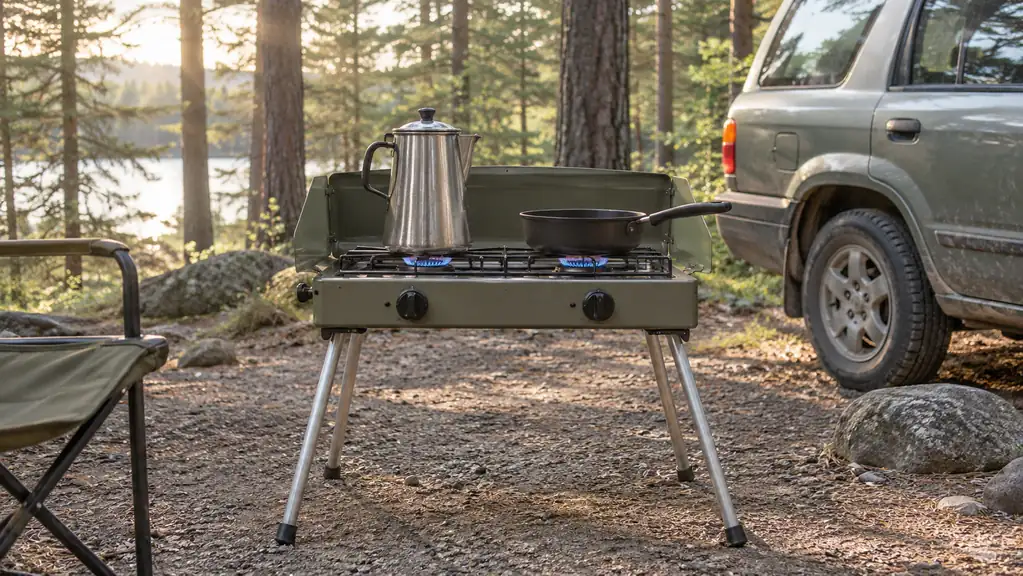
Here is the shape of it. Two cast-aluminum burners at 30,000 BTUs each, 60,000 total, fed by a standard 20-pound propane tank through the three-foot hose and regulator that come in the box. Detachable steel legs. A three-sided windscreen. Appliance-style knobs instead of the little lever you wrestle with on a cheap stove. It measures 34 inches long by 14 wide by 29 tall when it is standing, and I want you to hold onto that first number, because 34 inches is the reason some people should not buy this stove and the reason I am glad I did.
The Quick Verdict
A genuinely good two-burner camp stove for people who drive to their site and cook real food. It is campsite furniture, not a hiking stove, and the windscreen does less than you would hope when the wind comes across the site instead of at it.
Amazon Check Today's Price →Ten Weekends In, I Still Set It Up First
Two 30,000 BTU cast-aluminum burners, detachable steel legs, and a footprint that lives beside the car instead of on the picnic table. Check the current listing and full spec sheet on Amazon.
Amazon Check Today's Price on Amazon →The Part the Listing Buries: This Is Furniture, Not a Pocket Stove
Every camping stove write-up I read before I bought this one talked about heat output and ignitions and never once mentioned that the thing is 34 inches long. Thirty-four inches is not a stove you set on a picnic table while somebody else lays out the plates. It is a piece of equipment with its own address. On our usual site it stands on the gravel beside the Honda CR-V, the hose running off to the propane tank, and it stays put the entire weekend. I do not move it between meals. It becomes part of the campsite the way a grill becomes part of a patio at home. I paced off our usual gravel pad in April out of curiosity, and it runs about eight feet by ten. The stove takes a little under three feet of that along the edge, which sounds like nothing until you add the propane tank behind it and the folding table where the plates go. After that, the walk to the bathhouse has to thread between the stove and the chairs.
The detachable steel legs are what make that possible. They come off for travel and go back on in a minute or two, and once they are on, the stove stands at a working height. That matters more to my lower back than I expected when I ordered it. I am 57 and my back is stiff in the mornings. Bending over a low stove to turn eggs is the kind of thing that can sour a whole day before it starts. Standing at this one, with the skillet at roughly counter height, is the single biggest reason I kept it instead of handing it to a neighbor the way I did with my old single-burner.
The other detail the listing states plainly and buyers skim right past is the 14-inch system compatibility. Camp Chef builds accessories around that 14-inch footprint, and the stove is designed so those accessories drop into the space where a burner normally sits. I have not bought any of them, so I am not going to pretend I can vouch for how they fit. I am telling you it exists because it changes what the stove is: not just two burners, but a platform other pieces attach to. If you are the sort who wants a griddle at the campsite, that matters. If you are not, ignore it.
How Ten Weekends Actually Went
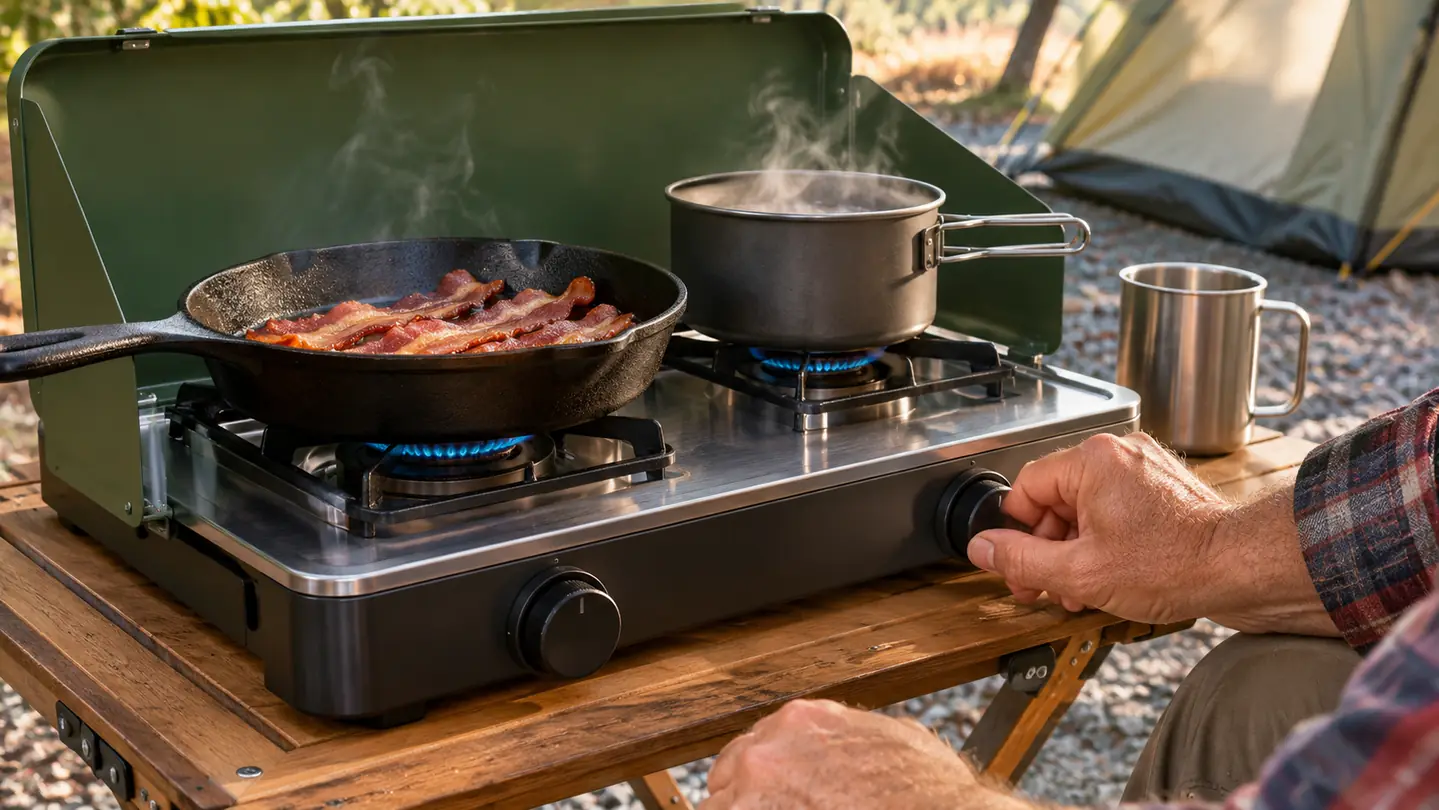
Breakfast is the test. Bacon first, in a cast iron skillet on the left burner, because bacon tells you immediately whether a stove holds heat or spikes and drops on you. Then eggs on the right, and pan-fried potatoes in the bacon fat once the bacon comes off. Three things going, one of them greasy, on a stove that has been loaded and unloaded ten times. It has handled all of that without complaint. The knobs turn smoothly and hold where I put them, which sounds like nothing until you have cooked on a stove where the flame creeps up on its own while your back is turned. The first morning in March I had the skillet too hot and the bacon went from limp to dark in under a minute, and that was the cook, not the stove. By the third weekend I had learned to set the left knob a hair above low and leave it alone. Roughly twenty breakfasts later, that is still where it sits.
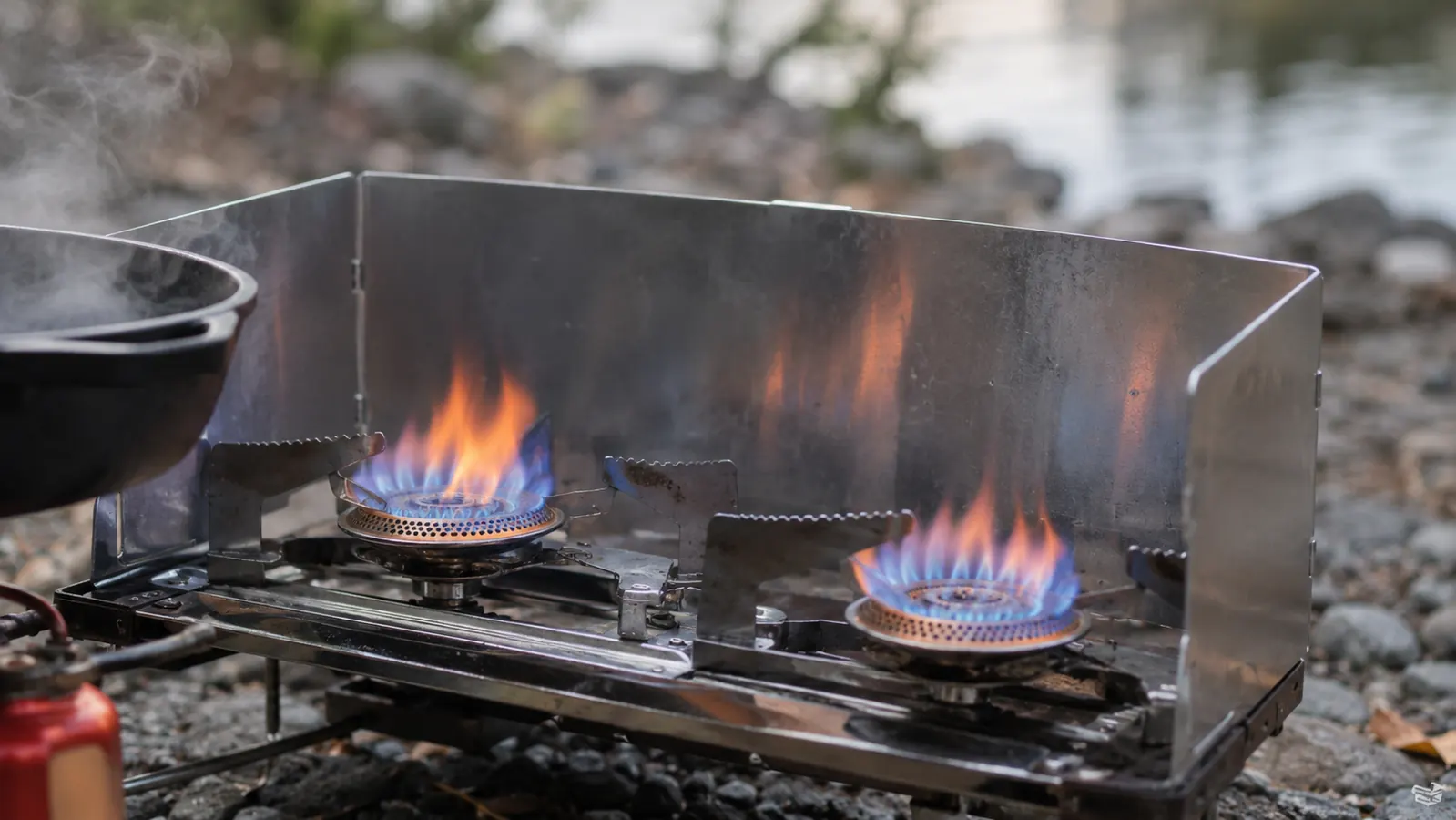
Wind is the honest test, and the honest answer is mixed. The three-sided windscreen wraps the burners and does real work when the wind comes from one direction. On a morning when it comes across the site at an angle, the screen is on the wrong side for at least one burner and the flame leans. I have never had a burner blow out entirely. I have had to turn one up higher than I wanted in order to hold a simmer, and that is exactly how the potatoes got away from me on that Sunday.
Cleanup is easier than I expected. The burners lift out, the steel wipes down, and the grease that misses the skillet lands on a surface I can reach with a rag. What I have not solved is the drips that run down between the burner wells and the frame. There are corners on this stove a campground rag is not going to reach, and by Sunday afternoon in August mine had a few. Not a deal breaker. It is a thing I notice every trip.
Setup, the Hose, and the Tank
Setup is not complicated, but it is not instant either. Legs on. Hose and regulator threaded onto the tank. Tank valve open. Then the knob. Ray handles the tank because he is better about checking the connection than I am, and I handle the legs and the windscreen. From the back of the CR-V to a lit burner is a few minutes, and most of that is me being fussy about where the stove sits relative to the tent and the chairs. The first attempt in March took closer to ten minutes. I had two legs on the wrong corners, and I spent a while convincing myself the regulator threads were crossed when they were not. By the second trip I had the order memorized: legs, windscreen, hose to the tank, tank valve, then the knob. Now it is muscle memory, even at six in the morning. Takedown at the end of a weekend is shorter, though I let the burners cool before I touch anything, which is the one rule I do not bend.
The three-foot hose is worth thinking about before you buy. It is long enough to keep the 20-pound tank off the stove and out from underfoot, and short enough that the tank and the stove have to live in the same little patch of ground. I set the tank just behind and to the left, out of the walkway to the bathhouse, and that has worked for eight months. The hose and regulator come in the box with the Camp Chef, so there was nothing else to buy before the first trip except the tank itself. I only ever run this stove outdoors. Not in the tent, not under a closed shelter, not in the screen room with the flaps down. That is not a caution I am adding for legal reasons. It is how I actually use it.
The Burners, the Knobs, and the Windscreen
Thirty thousand BTUs per burner is more than I need, and I want to be straight with you about that. I have never turned either knob past the halfway mark except to boil water, and water boils fast. The value of the extra output is not that you cook hotter. It is that the stove recovers quickly. Put a cold skillet on, and the pan comes back up to temperature in a fraction of the time a smaller stove takes. That recovery is what makes two dishes at once actually work instead of turning into a waiting game where one plate goes cold.
The appliance-style knobs are the feature I would fight to keep. They are big, they turn like the stove at home, and they give you a low flame you can genuinely hold. My old single-burner had one lever with a range that went from off to scorch with nothing useful in between, and simmering on it was a guess every time. Here I can put a pot of coffee on the left burner at a low flame, walk the 200 yards to the bathhouse, come back, and it is still coffee and not a scorched pan. What the knobs do not have is a marking I can read at dusk without my headlamp, so I have learned the positions by feel. Off is full left. Low is about a quarter turn in from there. My hand knows it. A neighbor borrowing the stove for a pot of beans does not, and I end up standing beside him pointing at the knob.
What I Liked
- Stands at working height on its own detachable steel legs, which saves a stiff back on a cold morning
- Two 30,000 BTU cast-aluminum burners recover heat quickly when a cold skillet goes on
- Appliance-style knobs hold a genuine low flame for coffee and for simmering
- Runs off a standard 20-pound propane tank through the three-foot hose and regulator in the box
- Burners lift out and the steel wipes clean without much fuss
- The three-sided windscreen does real work when the wind comes from one direction
Where It Falls Short
- 34 inches long by 14 wide, so it needs its own patch of ground beside the vehicle
- The windscreen is on the wrong side when the wind crosses the site at an angle
- Grease finds corners between the burner wells that a camp rag cannot reach
- One year limited warranty is short for a piece of equipment this size
- Not a stove you carry anywhere. It lives where you park
- Setup and takedown cost a few minutes at each end of the trip
I have cooked about twenty breakfasts on this stove and never once had a burner go out. What I have had is a flame that leans when the wind comes across the site instead of at it.
What I Would Change
Two things. First, the windscreen needs a fourth panel, or a way to reposition the three it has. The screen is fixed to the frame and wraps the burners on three sides, and the open side stays the open side no matter what the weather is doing. When the wind crosses the site, one burner is shielded and the other is not. I have solved this with a folded camp chair wedged into place, which is a silly thing to admit about a stove that ships with a windscreen.
Second, I would like the frame to shed grease better. The corners between the burner wells collect it, and after ten weekends I can see the buildup in exactly the places the rag cannot get to. It is a small design detail and it would cost nothing to fix. Camp Chef makes a good product here. This is the kind of thing a company only learns from people who cook on the thing forty times, and I have gotten about that far.
What I would not change is the size, and I know that runs against what a lot of people say. Yes, 34 inches is a commitment. But the commitment buys a stove at counter height with room for a skillet and a pot side by side, and if I wanted something smaller I would be back to cooking one thing at a time on a picnic table with my knees complaining. The size is the trade. I took it and I would take it again.
The Burn Ban Weekend
One July weekend the county was under a burn ban. Campfires were off and the campground office had signs up about it. I walked over and asked whether the propane stove was allowed, because I did not want to assume either way. The answer at that campground, that weekend, was yes. A stove with a contained flame and a shutoff valve is a different animal from an open fire, and the office treated it that way.
I bring this up because I have watched campers get it wrong in both directions. Some assume a propane stove is always fine under a ban. Some assume everything is banned and eat cold sandwiches for three days. Neither is a safe assumption. The rule is local, it changes with the weather, and it is set by whoever runs that piece of ground. Ask at the office. It takes two minutes and it is the difference between a hot breakfast and a bad morning.
Who This Is For
This stove is for people who drive to their campsite, park, and stay put. If your site has a vehicle beside it, if you cook real meals instead of boiling water, and if you have ever wished you could have coffee going on one burner while the skillet works on the other, this is the stove that does that. It suits couples. Ray and I are two people and one stove is plenty for us. It suits anyone with a stiff back who is tired of crouching over a low flame. And it suits anyone who already owns a 20-pound propane tank, because that is the fuel it wants and the hose and regulator come with it.
Who Should Skip It
Skip it if you backpack, and skip it if your site is a walk-in more than a short carry from where you park. I am not going to quote you a weight, because I have never put this stove on a scale and I am not going to pass along a number I did not check myself. I will tell you what I know: it is an alloy steel frame with two cast-aluminum burners and four detachable steel legs, and it is not a thing you carry. It rides in the back of the CR-V and it comes out once at the start of the weekend.
Skip it also if you camp out of a small car with no room for a 34-inch piece of equipment, and skip it if you mostly boil water for freeze-dried meals. A single burner handles that job with far less space and far less fuss. And skip it if you want a stove that sits on a picnic table. This one wants ground, and it will take up more of your site than you picture when you order it. I know, because I pictured less.
If You Cook Breakfast at the Campsite, This Is the One I Would Buy Again
Two 30,000 BTU burners, detachable steel legs, a three-sided windscreen, and a three-foot hose and regulator in the box. Check today's price and the current listing on Amazon.
Amazon Check Today's Price on Amazon →