
I bought the Camp Chef Explorer 2-Burner in the first week of March, along with four other pieces of gear I had been putting off replacing. My husband Ray and I camp about ten weekends a season at state parks in north Alabama, and the last thing I wanted was to spend a season learning a stove. So I set it up in the driveway the day it arrived, boiled a pot of water I did not need, and told myself I was being thorough. I was being a little impatient, and also a little nervous, because the small single-burner it replaced had been annoying me for years.
Eight months later, that stove has cooked every breakfast of every camping weekend we took, from March through October. It has run through one burn ban, one windy weekend where I thought I would have to fall back on sandwiches, and roughly forty rounds of bacon, eggs and pan-fried potatoes. This is what I know about it now that I did not know in March.
The Quick Verdict
A genuinely capable two-burner for car campers who cook real meals and have room for a 20-pound tank. If you boil water and call it dinner, it is more stove than you need.
Amazon Check Today's Price →See what the Explorer costs today, and what the burners actually deliver
Two 30,000 BTU cast-aluminum burners, detachable steel legs, a three-sided windscreen, and the three-foot hose and regulator in the box. The listing has the full spec sheet and the current price.
Amazon Check Today's Price on Amazon →How I've Used It
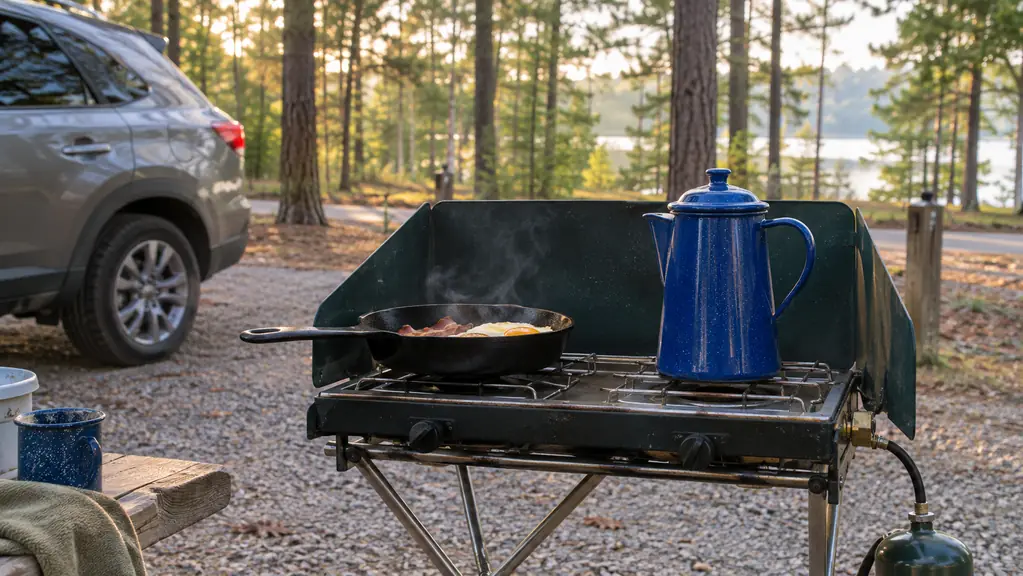
Our campsite routine is the same almost every trip. I pull into the site, Ray unloads the car, and I set the stove on its own legs on the gravel beside the CR-V. The legs detach for travel and slide back on in about a minute, and the stove stands at a comfortable working height. The listing gives the height as 29 inches, and that lands about counter height for me, rather than down at the ground like the little single-burner I used for years. That one detail changed how much I enjoy cooking outdoors. Bending over a low burner at 57 years old with a stiff lower back in the mornings is not the romantic part of camping.
The first trip out was the second weekend in March, at a state park about forty minutes from the house. We got a late start and I set up in the dark, fumbling the hose connection while Ray held a flashlight at a bad angle and offered opinions. The hose is three feet, which is enough to set the tank off to the side and out of the way of your feet, and once I understood which way the fitting wanted to turn it stopped being a problem. By June I could do the whole thing by feel: legs on, hose to the tank, tank valve open, burner lit. Two or three minutes, and most of that is walking back to the car for the lighter I forgot.
The stove runs off a standard 20-pound propane tank through the hose and regulator that come with it. I keep the tank in the car and set it beside the stove once we are parked. Coffee goes on one burner, the cast iron skillet goes on the other, and the two of them work at the same time without either one losing steam. That is the entire reason I bought a two-burner. For about ten years before this, breakfast for two people happened on one burner, and the ritual was always the same: boil the water, pour the coffee, cook the food, then reheat the coffee because it had gone cold while the eggs were going.
Every one of those meals was cooked outdoors. I have never used it in the tent or in a closed shelter, and I would not. The three-sided windscreen that comes with it clips on and stays on, and I have left it attached all season because it does not get in the way of a skillet or a pot. On a breezy Saturday in April it was the difference between a flame that sits where you put it and one that flutters and annoys you. On the wet May weekend I waited for the rain to pass before I lit it, because I will not run a stove under anything closed in.
What 60,000 BTUs Actually Buys You
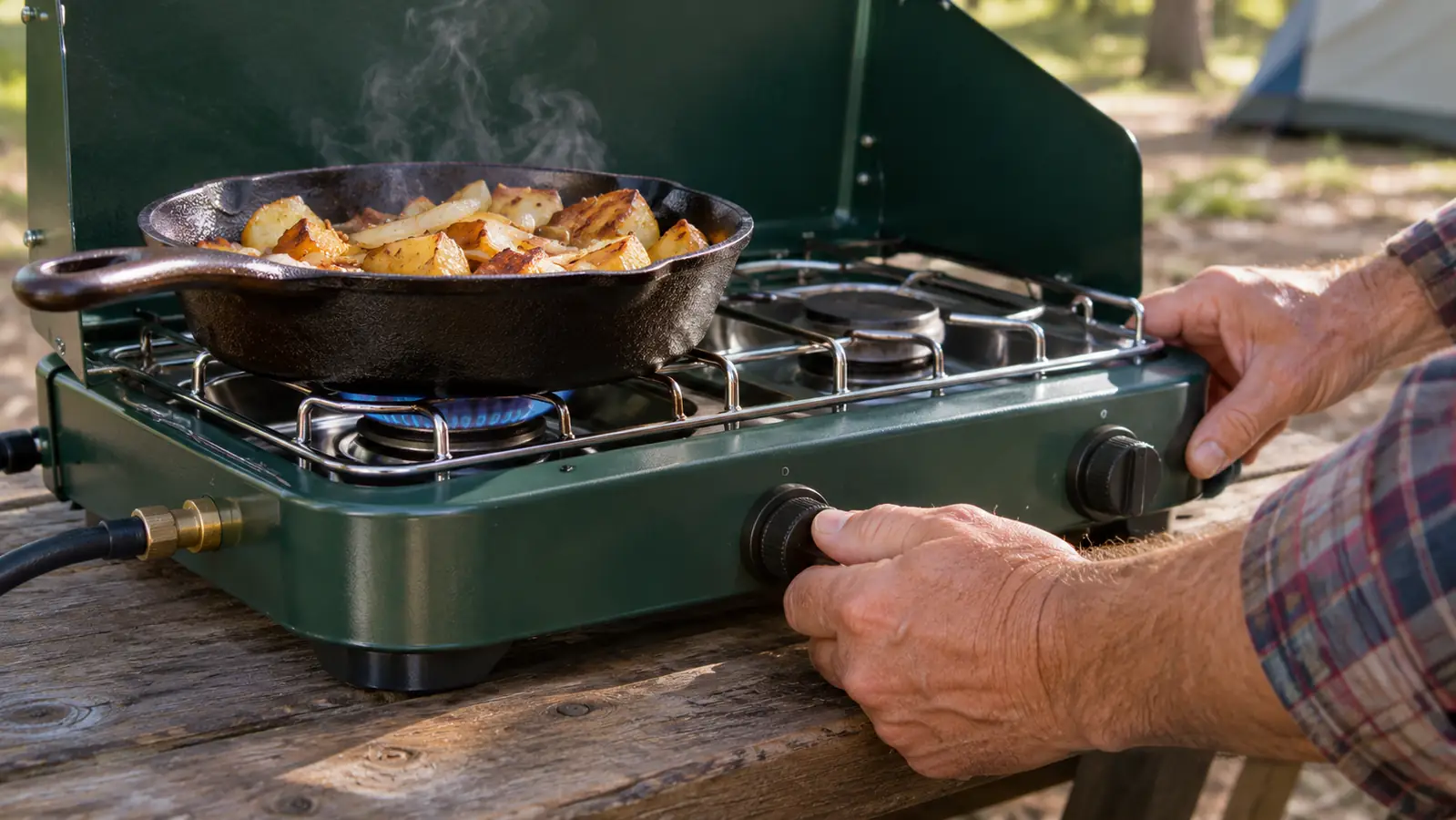
The headline number on the Camp Chef Explorer is 60,000 total BTUs, split across two cast-aluminum burners at 30,000 each. On paper that is a big number. In practice it means two things I care about: a pot of water gets to a boil fast enough that I am not standing there watching it, and the skillet recovers its heat when I drop a pound of cold bacon into it instead of sulking for five minutes.
The part I did not expect to like was the knobs. They are appliance-style, which sounds like marketing language until you actually use them. You can turn one down to a low simmer and leave it there. My old single-burner had a control that went from off to hot to hotter, and if you wanted eggs that were not rubber you had to hover over the pan and lift it every thirty seconds. With this one I can put the potatoes on a low burner to hold while the eggs cook on the other, and then sit down and eat them while they are still hot.
Here is what that looks like in real time, because I timed it once out of curiosity on a still morning in May. A quart and a half of water in an enamel pot, lid on, one burner going: it was at a rolling boil in a little over six minutes. The skillet of diced potatoes takes about fifteen minutes to get properly brown, so I start those first, then start the coffee, then crack the eggs in the last three minutes. The whole breakfast is on the table in under twenty minutes, which matters on a morning when you want to be on a trail by eight and the drive to the trailhead is another twenty.
What 60,000 BTUs does not buy you is quiet. This is not a subtle stove. When both burners are wide open you can hear it, and if the campground has quiet hours that start at ten, you will be conscious of it if you are making a late dinner. It also puts out real heat around the cooking surface, so on a warm July morning you will feel it on your arms and you will not want to stand directly over it in a sleeveless shirt. Neither of those is a flaw. It is just what a big open flame does, and I would rather have the heat than not have the flame.
The Burn Ban Weekend
One July weekend the county had a burn ban in place. Campfires were off, which took away the whole evening for a lot of people on the loop. I walked up to the campground office and asked before I cooked anything, and they told me a propane stove was fine. So we cooked as usual and had a good weekend. Two sites down from us packed up and left Saturday morning, which I thought was a shame, because they could have asked the same two-minute question I asked.
I want to be careful about how I say this, because it is the kind of thing people repeat as if it were a rule. A propane stove is not automatically allowed just because it is not a campfire. It depends on the county, the park and how the ban is written, and it can change from one weekend to the next. Ask at the office. It took me two minutes and I got a straight answer, and if the answer had been no I would have eaten cold food and not argued about it.
One stove, two burners, and no firewood required
On a no-campfire weekend the Explorer kept us eating hot breakfasts and hot dinners. Same two burners, same 20-pound tank, same hose and regulator in the box. Ask your campground first, then cook.
Amazon Check Today's Price on Amazon →Where It Gets Awkward
The 20-pound tank is the honest cost of this stove. It is not the stove's fault, but it is the reason the Explorer is a car-camping appliance and not something you carry. You are not putting a full propane tank in a day pack. Earlier in the summer I looked at a walk-in site on the far side of the same park, about a quarter mile from the parking lot, and I did the arithmetic in my head and booked the drive-in site instead. If a walk-in site is the kind of camping you want, this is the wrong tool and I would not talk you into it.
The frame is alloy steel, and it is built like something that expects to be used hard. That is good for stability and less good for lifting it in and out of the car alone. The legs detach, which helps a great deal, but the body of the stove is not a featherweight and I will not pretend otherwise. Mine lives in the back of the CR-V for the season now rather than coming inside between trips, and that solved it. Ray carries it when he is with me. When he is not, I take it in two trips and I do not make a production of it.
One thing worth knowing before your first trip: pick your spot with some thought. The stove wants level ground, and the gravel pads at state parks are usually flat enough but not always. Our usual site has a slight crown to it, so I set the legs on the high side and check with the back of my hand that the frame is not rocking before I put a skillet of hot grease on it. It takes ten seconds and it is the difference between cooking breakfast and chasing it.
Last thing: cleaning. Grease splatter gets on the frame and the windscreen, and pan-fried potatoes throw more of it than you would think. A rag and a little dish soap at the bathhouse sink handles it, but the stove is big enough that it is a five-minute job, not a wipe. I do it before we leave the site, because doing it in the driveway at home on Sunday afternoon is a chore I will put off until the grease has set and then resent.
What I Liked
- Two 30,000 BTU cast-aluminum burners run at once, so breakfast for two is not a relay race
- Appliance-style knobs hold a real low simmer, which matters for eggs and for holding potatoes
- Detachable steel legs put the cooking surface at a working height instead of at ground level
- Three-sided windscreen comes in the box and stays on, and it earns its place on breezy mornings
- Three-foot hose and regulator included, so a standard 20-pound tank is all you add
- Compatible with most 14-inch Camp Chef accessories if you want to build the setup out
Where It Falls Short
- Requires a 20-pound propane tank, which makes it car camping only
- Alloy steel frame is sturdy and correspondingly heavy to move alone
- Audible and hot when both burners are wide open
- Grease splatter on the frame and windscreen makes cleanup a five-minute job, not a wipe
Coffee on one burner, cast iron on the other, and neither one has to wait. That is the whole argument for this stove, and it held up for eight months.
How It Held Up Over Eight Months
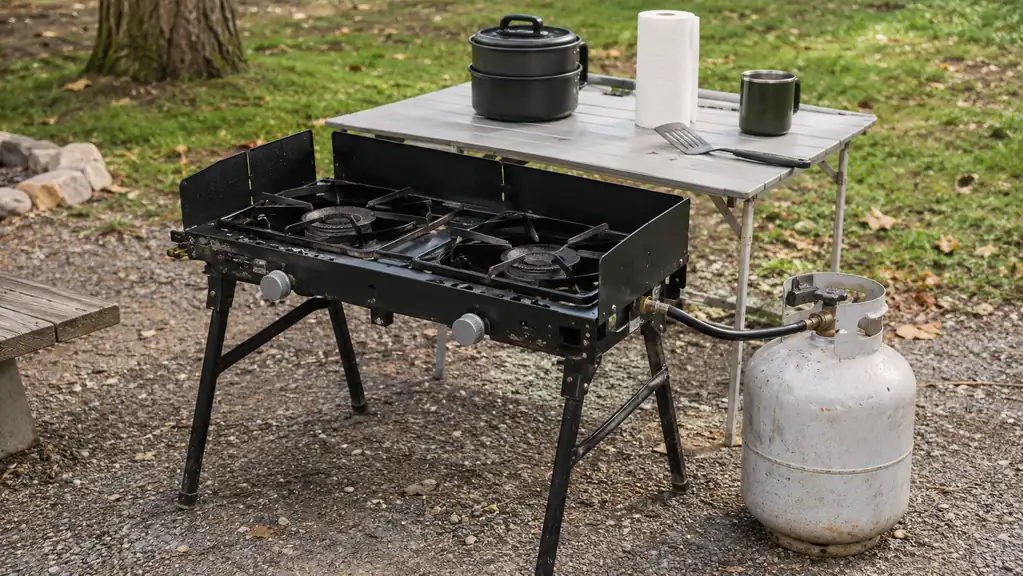
Nothing has failed. No knob has gone sticky, no burner has clogged, no leg has wobbled, and the windscreen still clips on the way it did in March. I have not had to take anything apart or order a part. For a stove that sat outside on gravel for roughly ten weekends and rode in a car in between, that is what I wanted and it is what I got.
The cast-aluminum burners still light on the first or second click of a lighter, and the flame pattern is even across the burner, not lopsided toward one side. I have run the same 20-pound tank all season and it is still going, which tells you something about how much propane two burners at breakfast actually use. It is not a lot. We cook breakfast and dinner on a camping weekend and I have not swapped a tank since March.
The last trip of the season was the second weekend in October, and it was cool enough in the morning that I was in a fleece and a knit hat. That was the morning I noticed the windscreen earning its keep twice over, because it blocks a little of the chill from your hands as well as the wind from the flame. The stove lit on the second try, same as it did in March, and the potatoes came out the same. Eight months is not twenty years and I am not going to tell you this stove is indestructible. I am telling you that nothing about it has gotten worse.
The one-year limited warranty is listed on the product page, and I have not needed to test it. I mention it only because it is the kind of thing you want to know exists before you find out whether it works.
Who This Is For
If you are a car camper who cooks actual meals, the Camp Chef Explorer is the stove I would point you at. Two burners that both mean it, a working height that does not wreck your back, and controls fine enough to cook eggs rather than just heat them. It fits a couple cooking breakfast together, and it fits one person who wants a skillet and a coffee pot going at the same time without negotiating with themselves.
It also suits the tailgate and the family reunion and the church parking lot, which is to say anywhere you drive to and want real cooking when you get there. And if your campground sometimes bans campfires, a propane stove gives you an option that does not depend on firewood, provided the office says yes that weekend.
Who Should Skip It
Backpackers, paddle-in campers and anyone whose site is a walk from the car should skip it without a second thought. The stove is only half the equation. The 20-pound tank is the other half, and that tank does not go on your back.
Skip it too if you camp solo and eat out of a pot. If your camp dinner is boiling water for a dehydrated meal and your breakfast is a granola bar, a two-burner with 60,000 BTUs is a lot of stove, a lot of steel and a lot of cleanup for a job a small single-burner does. I gave my old single-burner to a neighbor in March. If that is you, keep yours.
And skip it if you are not going to clean it. Grease left on a steel frame for a season turns into a scrubbing job. Five minutes at the bathhouse sink each trip beats an hour in the driveway in November, and that is advice I give myself as much as anyone.
If you cook real meals at a drive-in site, this is the one
Two 30,000 BTU burners, appliance-style knobs, detachable steel legs, a three-sided windscreen, and the hose and regulator in the box. Eight months in, mine still lights on the first or second try.
Amazon Check Today's Price on Amazon →