
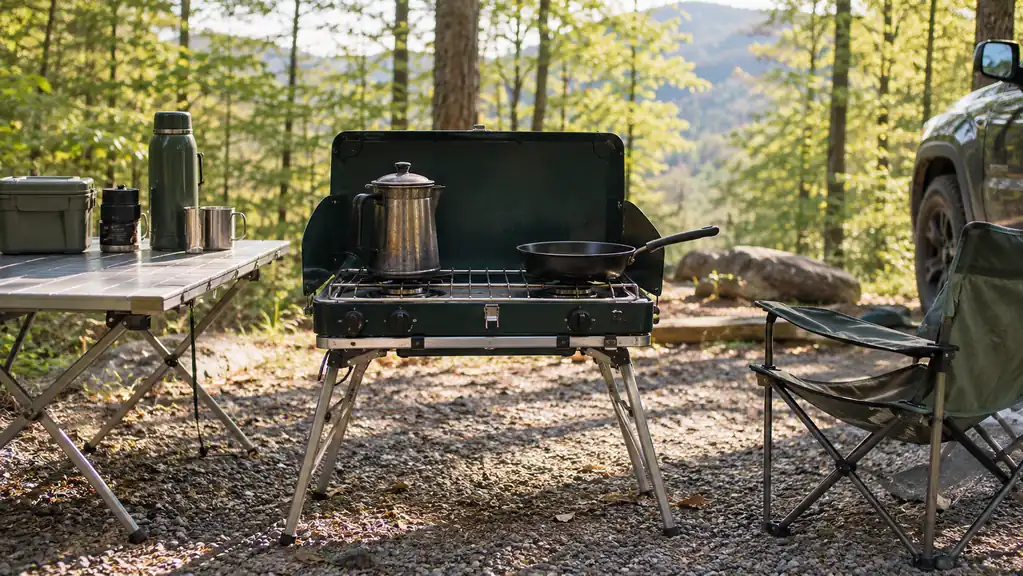
I bought the Camp Chef Explorer 2-Burner in the first week of March, and I have cooked on it most camping weekends since, usually beside our older Honda CR-V at a state park campground in north Alabama. My husband Ray and I are car campers, not backpackers. We do about ten two-night weekends a season, and most of those mornings start with coffee on one burner and a cast iron skillet on the other. That is the job I judge a stove by, because a stove that cannot handle bacon, eggs, and pan-fried potatoes without a fight is not much use to me.
So here is the short answer. For the way Ray and I camp, the Camp Chef Explorer is the better stove. The Coleman Triton 2-burner stove is a good stove for a different job. It is smaller, it runs on a disposable propane cylinder, and it is easier to carry from the car to a picnic table. If your camping is one night, one pot, and a quick exit in the morning, the Triton makes more sense. If you cook real breakfasts for two or more people and you have room for a 20-pound tank, the Explorer earns its space. I would not trade the Explorer for the Triton on a Saturday morning, but I would borrow a Triton for a quick overnight trip.
How I Compared Them
I have owned the Camp Chef Explorer since that first week of March and used it through one season, March to October. I have not owned the Coleman Triton. I have handled a neighbor's Triton at the campground, looked one over in a store, and read the published specs. I am 57, a retired dental hygienist, and I camp in the southern Appalachian foothills. That is enough to compare the jobs they do, but I am not going to pretend I have cooked a hundred breakfasts on a stove I do not own. Where I talk about the Triton, I am talking about what I saw and what the listing says, not a season of my own use.
My comparison comes down to four things: heat, fuel, footprint, and setup. Heat is about whether a skillet browns or steams. Fuel is about how long I can cook before I have to deal with a cylinder. Footprint is about whether the stove stands on its own or needs table space. Setup is about how much work it takes to get from the car to a hot burner. I care about those four things more than I care about a stove's looks, and I care about them more than I care about packing the smallest possible box.
| Camp Chef Explorer | Coleman Triton | |
|---|---|---|
| Total heat output | 60,000 BTUs from two 30,000 BTU cast-aluminum burners | Lower published output, built for lighter cooking |
| Fuel for a long weekend | Standard 20-pound tank through the included 3 ft hose and regulator | Small disposable propane cylinder |
| Portability | Detachable steel legs, but the stove and tank take up room in the vehicle | Smaller and easier to carry to a picnic table |
| Table space | Stands on its own legs beside the vehicle | Needs a flat table or a level rock |
| Best job | Basecamp breakfasts for two or more | Quick overnight trips and small groups |
Where Camp Chef Explorer Wins
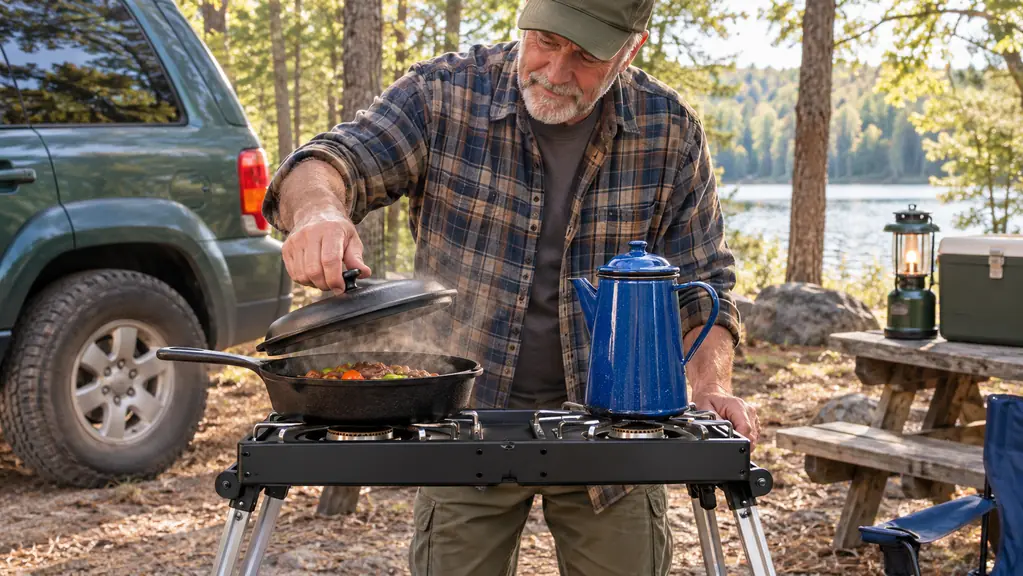
The first win is heat. The Explorer puts out 60,000 BTUs total, with two 30,000 BTU cast-aluminum burners. That matters when I have a cast iron skillet full of bacon, eggs, and potatoes, and I want the skillet hot enough to brown instead of steam. The Triton will cook breakfast. It just does it with less reserve, and on a breezy morning I would rather have more heat than less. I have used the Explorer in shade and in wind, and the burners have enough range to hold a low simmer on the coffee pot while the skillet runs hotter on the other side.
The second win is the fuel setup. The Explorer runs off a standard 20-pound propane tank through the included 3 ft hose and regulator. I set the tank beside the stove, open the valve, and I am cooking. A 20-pound tank lasts me most of a season of weekends, so I am not swapping small cylinders every trip. The Triton's disposable cylinder is simpler to carry, but it is another thing to buy and pack, and it runs out faster. If I am feeding Ray and me for two nights, I do not want to think about fuel on Sunday morning.
The third win is the stand. The Explorer has detachable steel legs and stands on its own beside the car. I do not have to clear the picnic table or find a flat rock. The frame is 34 inches long, 14 inches wide, and 29 inches high with the legs on, so there is room for a skillet and a coffee pot without crowding. The three-sided windscreen is included, and it makes a difference on the breezy mornings we get in the foothills. I have had mornings where the coffee pot stayed hot and the eggs did not take forever, and the windscreen is part of why.
The fourth win is the accessory system and the knobs. The Explorer is compatible with most 14 inch Camp Chef accessories, so the same stove can take a different cooking setup later. I have not bought those accessories, but I like knowing the stove is not a dead end. The appliance-style knobs also give me a fine enough adjustment to hold a low simmer on one burner while the other burner runs hotter. That is not a small thing when you are cooking two things at once and one of them is coffee.
The Explorer also has a 4.7 star average across more than 9,500 reviews on Amazon. I do not buy gear by review count, but a number that large tells me the stove has been used by a lot of people in a lot of campsites. My own experience lines up with that. After one season, the legs still lock in, the knobs still turn smoothly, and the windscreen still fits the frame. I have not had to baby it.
Where Coleman Triton Wins
The Triton wins on portability, and I mean that without a qualifier. The Explorer is a basecamp stove. It has legs, it wants a 20-pound tank, and it lives beside the vehicle. The Triton is a smaller package that sits on a picnic table, and if I were packing for a one-night trip in the CR-V with a cooler and a tent, I would rather carry the Triton. It is less stove than the Explorer, but it is also less to load, less to set up, and less to clean around. For a quick trip, that trade is real.
The Triton also wins on simplicity. There is no hose and regulator to connect, no 20-pound tank to strap upright, and no legs to attach. You set it on a flat surface, connect a small cylinder, and cook. For a couple of people doing a simple supper and a pot of coffee, that is enough. I have watched a neighbor cook on one at the campground, and it did the job without drama. He had it lit and had a kettle on before I had my skillet on the Explorer. That is not a race I need to win, but it shows what the Triton is built for.
The Triton wins on fitting into a small site, too. Some of the sites we use have a narrow pad and a picnic table close to the fire ring. The Explorer stands on its own legs, which is a plus, but it also takes up a footprint. The Triton on the table leaves the ground clear. If you camp in a small trailer or a tent with limited room in the vehicle, that matters more than burner output. It is also easier to move out of the way if weather comes in.
What the Triton does not win is heat reserve and long-weekend fuel. Its published output is lower than the Explorer's 60,000 BTUs, and the small cylinder is not a long-weekend fuel source. That is not a knock if you are boiling water and cooking one skillet. It is a real limit if you are feeding four people bacon and eggs on a windy morning. I would also rather have the Explorer's three-sided windscreen when the wind gets under the pot. That is a published feature on the Explorer, and it is the kind of thing I notice on a breezy morning. The Triton is still a good stove for a quick trip, but it is not the stove I would choose for a crowd.
What a Real Breakfast Looks Like on the Explorer
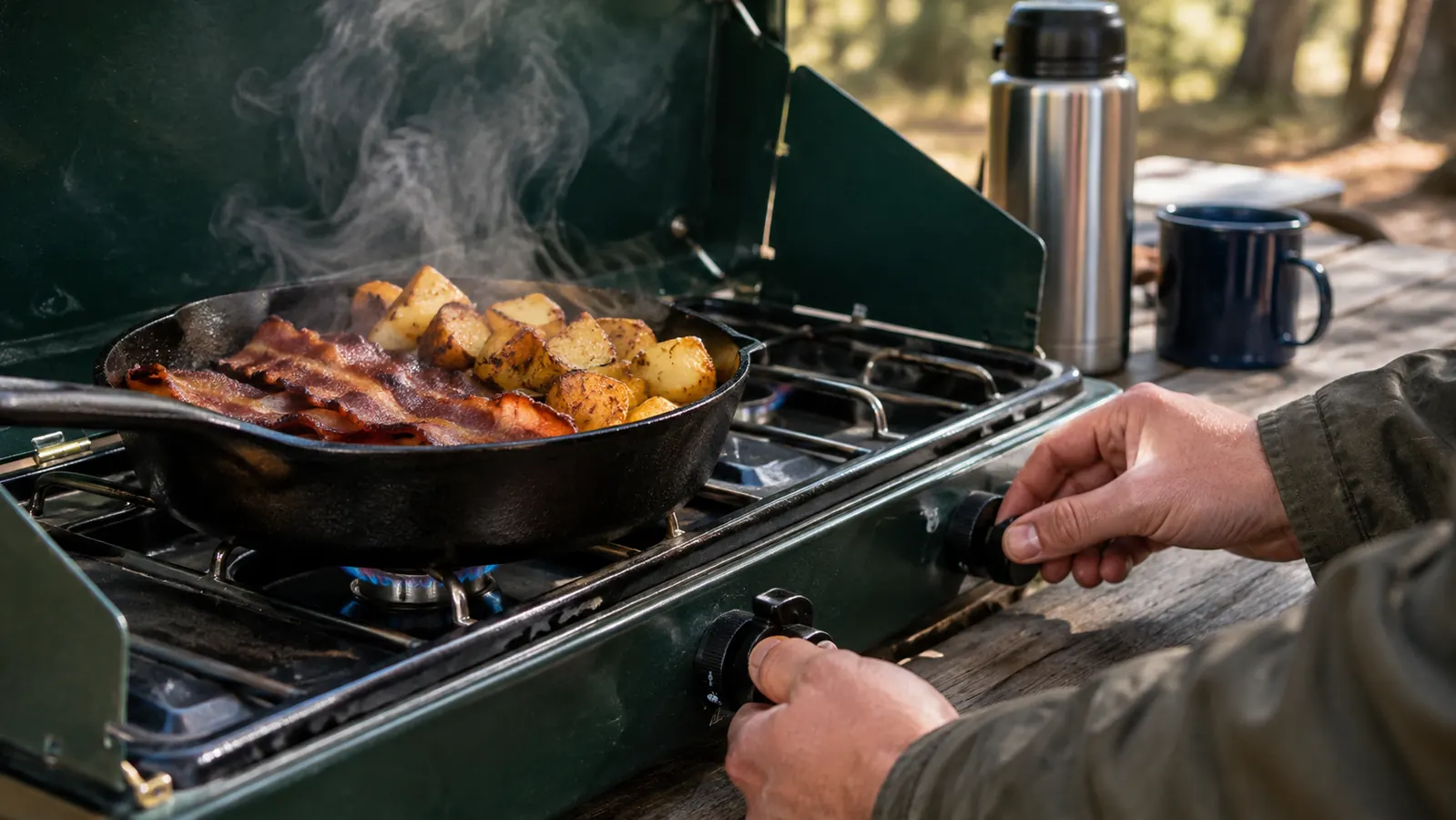
On a typical Saturday, I set the Explorer on its legs beside the CR-V, connect the 20-pound tank, and turn on the left burner for the coffee pot. The right burner gets the cast iron skillet. I start bacon first because it gives me fat for the potatoes, then I add the potatoes and let them brown while the coffee perks. The two 30,000 BTU burners give me enough heat to keep the skillet going and enough control to keep the coffee from boiling over. Ray usually comes out when the bacon smell reaches the tent. That is the whole review, really: the stove makes a real breakfast possible without a lot of fuss.
Cleanup is not bad either. I let the stove cool, wipe the surface, and fold the legs in. The windscreen comes off, and the hose coils around the tank. It all goes back in the CR-V in a few minutes. I do not have to scrub a grate on my hands and knees, and I do not have to find a table. That matters at the end of a weekend when I am tired and my back is stiff. The Explorer is not a small stove, but it is a simple stove to live with once it is set up.
If You Want the Basecamp Stove I Use Most Weekends
The Camp Chef Explorer 2-Burner is the stove I bought in March and still cook on. It has two 30,000 BTU burners, a three-sided windscreen, and detachable steel legs.
Amazon Check Today's Price on Amazon →Who Should Buy Which
Buy the Camp Chef Explorer if you cook for two or more people, if you want a 20-pound tank to last the weekend, and if your camp is a car camp with room for a stove that stands on its own legs. It is also the better choice if you use cast iron, because the two 30,000 BTU burners give you the heat to brown and the room to run a coffee pot at the same time. I would buy it again for the way Ray and I camp. It has earned its place beside the CR-V.
Buy the Coleman Triton if you camp light, if you mostly boil water and cook one skillet, and if you want a stove that fits on a picnic table and goes back in the car without a tank and hose. It is also the better choice for a small trailer or a tent site with a narrow pad. Just go in knowing that the smaller cylinder and lower output are part of the deal. If you want a stove for a quick overnight trip, the Triton is the easier companion. If you want a stove for a long weekend of real cooking, the Explorer is the better tool.
The Explorer is the better stove for a real breakfast. The Triton is the better stove for a quick exit.
My own choice is the Explorer because I cook a real breakfast most mornings and I have the room in the CR-V for the tank. If I were solo, or if I were packing for one night, I would look harder at the Triton. That is the honest split. Neither stove is wrong. They are built for different weekends, and the trick is knowing which weekend you actually take.
The Stove That Earned Its Place Beside the CR-V
Two 30,000 BTU burners, a three-sided windscreen, and detachable steel legs. The Camp Chef Explorer 2-Burner is the stove I use on most camping weekends.
Amazon Check Today's Price on Amazon →