
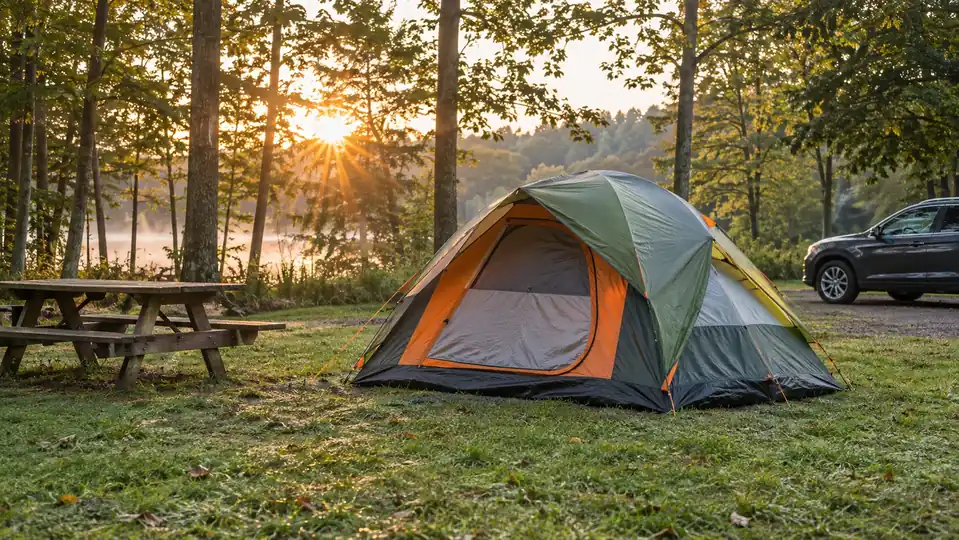
The thing nobody mentions about the Coleman Sundome is that the number on the box is a sleeping number, not a living-room number. Four people fit in it the way four people fit in a small car. I knew that before I bought it, and I bought it anyway. My name is Joanne Tillery. I am 57, retired from dental hygiene, and I live outside Fort Payne, Alabama, where I have camped the state parks of the southern Appalachian foothills for close to twenty-five years.
I bought this tent new in the first week of March, part of a slow replacement of gear I had put off for far too long. It took the place of an old generic tent whose zipper had finally quit, which went into the trash in February. From March through October, about eight months and ten two-night weekends, my husband Ray and I slept in it. We are two people plus two duffel bags, and the cooler stays in the car. This is the honest version of the Coleman Sundome: what it does well, where it stops, and what I would change if the company asked me.
The Quick Verdict
A plain, genuinely dry three-season tent that two adults can pitch alone. Buy it for the rectangular floor and the rainfly, not for the four-person label.
Amazon Check Today's Price →Ten weekends, one all-night rain, and I stayed dry
The Sundome is not fancy. It is a rectangular floor, pole sleeves, and a fly that does its job. If that is what you want from a car-camping tent, it is worth a look at today's price.
Amazon Check Today's Price on Amazon →How I Have Used It
Context matters with tents, so here is mine. Ray and I do two-night car-camping weekends at Alabama state park campgrounds, the kind with a bathhouse and a gravel loop road. No backpacking. No backcountry. The walk from our usual site to the bathhouse is about two hundred yards, which is the closest this tent ever gets to being carried.
It goes up in roughly the same spot every time, on grass or hard-packed dirt, and it stays up for two nights. We sleep two in it and keep our bags at our feet or along the wall on the side away from the door. I have never put four adults inside and I would not want to. I have put two adults inside with room left over, and that is the honest reading of the label. Ray is a quiet sleeper. I am not, and I have not once felt like I was sleeping in a coffin, which is more than I could say about the tent this replaced.
Ray unloads the car while I pitch. That is the arrangement, and it is the reason fifteen minutes is a real number and not a boast.
The Setup Gets Easier, and Then It Stays Easy
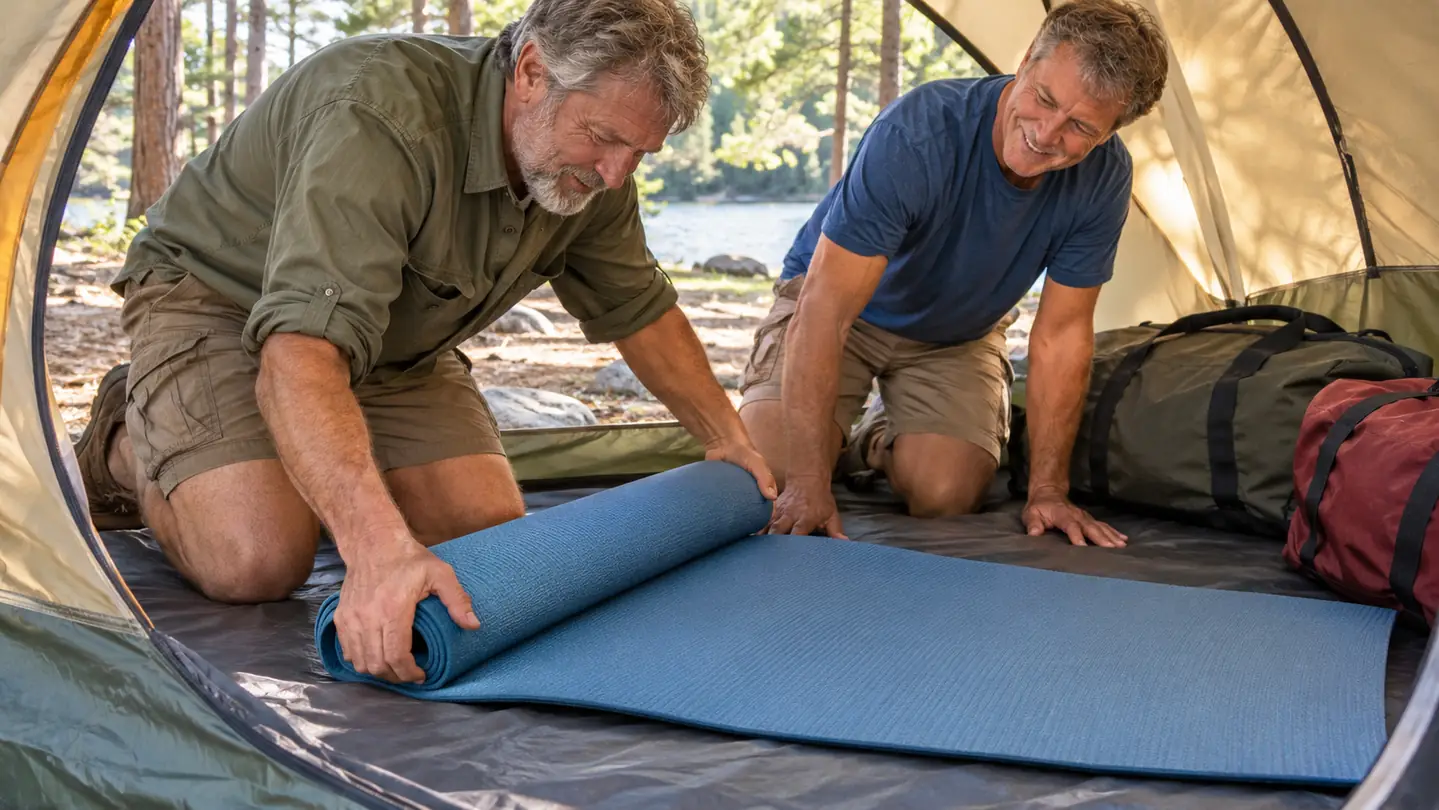
The first pitch was in the backyard in March, in the cold, with the wind doing what wind does. Thirty minutes, most of it spent reading the pole sleeves and figuring out which end was which. The sleeves are what slows a first-timer down. You feed each pole through a fabric tube rather than clipping it to the outside, which takes longer the first two times and then becomes something your hands know.
By the third weekend I was at fifteen minutes by myself, bag to standing. The frame is free standing, so it holds its shape before you stake anything. That means you can pick the whole thing up and move it two feet to the left when you realize you are camped on a root. I did that more than once this season.
The zipper has not caught, skipped, or split once in eight months of use, which is more than I can say for the tent it replaced. That is a low bar, I know. It is also the exact reason I was shopping in February.
One thing I would tell a first-timer: put the rainfly on before you are tired. It goes on easily enough in daylight, and it is a colder, clumsier job at ten at night with a flashlight in your teeth.
The Rainfly Is the Part That Matters
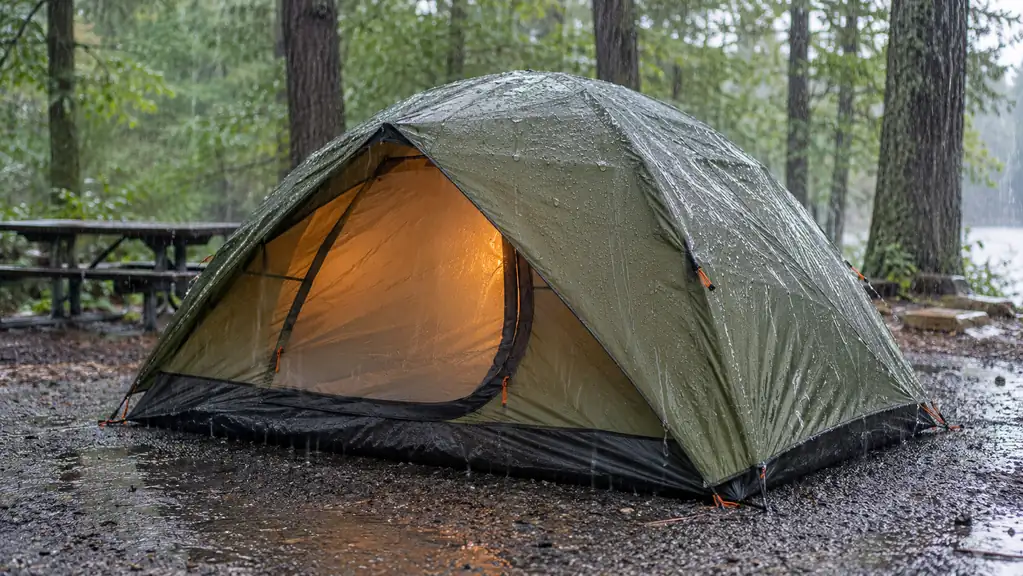
We had one hard rain this season, an all-nighter in May that started around eleven and did not quit until nearly five in the morning. The fly was on. I woke up twice and put my hand flat against the inside of the wall. Dry both times. In the morning there was a little condensation on the ceiling mesh, which is ordinary for two people breathing in a closed tent, and nothing that dripped on us.
The listing gives the coating as 1500 mm water resistance, which is not the highest number you will see printed on a tent. I am reporting the night rather than the number. One hard rain, one dry tent, and I would still fit the fly for anything heavier than a drizzle.
What I cannot tell you is how it handles a three-day soaking or a sideways storm on an exposed ridge. We do not camp on ridges. We camp in shaded loops with trees on three sides, and that is where this tent has lived. If your camping looks like mine, the answer is that it kept us dry.
The Floor Space Math
Sixty-three square feet, rectangular, no odd corners. That shape is the quiet reason I like this tent. A rectangle means two sleeping pads sit side by side with a gap between them instead of a taper that shoves one of you into the narrow end.
The four-person figure is a sleeping count. Four adults would be shoulder to shoulder with nowhere to set a bag, and nobody would be sitting up. Two adults with a duffel each and a bit of room to dress in the morning is the realistic use, and it is a comfortable one. Three small children would also fit. Four grown men on a fishing trip would not, at least not happily.
Ten pounds in the carry bag, per the listing. That is nothing in the back of a car and it is a great deal on your back, which is fine, because this is not a backpacking tent. If you plan to carry your shelter more than a mile, this is the wrong tent and you probably already know that.
Pitching It Alone, Which Is the Real Test
I am 57 and my lower back is stiff in the mornings. Nothing diagnosed, nothing operated on, just the ordinary stiffness of a woman who spent thirty years leaning over patients. So the question I actually care about is not whether a tent is easy for a fit person. It is whether I can do it alone, before coffee, without paying for it the next day.
The answer here is yes, with a caveat. The free-standing frame does most of the work. Once the poles are through the sleeves and the ends are seated, the tent stands on its own and I can walk around it and set the corners. I do not have to hold it up with one hand while threading a pole with the other, which was exactly the problem with the old tent and the reason it became Ray's job.
The caveat is the bending. Seating the pole ends at the corners means crouching four times, and staking means crouching a few more. I do it in stages and I take my time. Fifteen minutes is my number on a good morning and twenty on a bad one, and I have never once needed Ray to finish it for me.
What the Tent Does Not Do
It does not let you stand. The peak is low enough that I dress sitting down, and I am five foot four. Ray, who is taller, has learned to do everything in a crouch. This is a sleeping tent, not a changing room, and the sooner you accept that the happier you will be.
It does not give you a vestibule worth the name. There is a small overhang at the door and that is where the boots go. If it rains all night, the boots get wet. I keep a plastic bag in the car for exactly this, and I am not proud of it.
It does not carry a temperature rating, and I would not trust one if it did. Three-season is the claim, and three-season in Alabama means most of the year. It does not mean a hard freeze in a Colorado October. The two windows and the mesh ceiling move air on a warm night. On a cold one, you will want a better sleeping bag than the one you own, and the tent will not save you.
And it does not fix a stiff back. I wake up stiff at home most mornings and I wake up stiff in a tent. What changed that was my sleeping pad, not my shelter. A tent keeps the rain off. That is the whole job, and this one does it.
The Small Annoyances Nobody Mentions
The carry bag is a tube with a drawstring, and getting the tent back into it is a two-person job the first few times. It gets easier when you fold rather than roll, and easier again when you stop caring whether the fold is neat. I am at the stage where the bag is full and slightly lumpy and that is fine.
Zipping the door from the inside, with the fly on and a breeze running, takes two tries more often than one. I started stepping out and zipping from the outside instead, and that solved it. Small thing. It took me half a season to think of it.
The tent is loud in wind. Not alarming, just present. The fly flaps, the walls move, and you hear all of it. I sleep through it now. The first night I did not, and I lay there composing a letter to the manufacturer about a product that was behaving exactly as advertised.
Condensation is the one that surprised me. Two people in a closed tent on a cool night put moisture on the inside of the fly no matter what anyone claims. I crack the window nearest my head and it is much better by morning. That is not a defect. It is weather doing what weather does.
None of these are reasons to skip the tent. They are the reasons a tent is built the way it is, and I would rather know them going in than find them at eleven at night in the rain.
What I Would Change
Clips instead of sleeves, for the first pitch of the season. The sleeves are sturdy and they hold a pole straight, and I understand why they are there. They are also the reason a beginner stands in a cold backyard for half an hour. By the third trip I had stopped caring, which tells you how much weight to give this complaint.
A bigger door. The single door is fine for two people who go to bed at the same time and get up at the same time. It is less fine at two in the morning when one of you has to climb over the other to get out.
And a longer overhang over the door. Six more inches of fly and I would have somewhere to leave wet boots, and I would not be writing about a plastic bag in the car.
What I Liked
- Stayed dry through a hard all-night rain in May with the fly fitted
- Free-standing frame means one person can pitch it, back trouble and all
- Rectangular 63 square foot floor fits two adults and their bags without a puzzle
- Two windows and a mesh ceiling move air on warm nights
- Zipper has not caught, skipped, or split in eight months of weekends
Where It Falls Short
- The four-person label is sleeping capacity, not room to sit up
- Peak is low enough that you dress sitting down
- No real vestibule, so wet boots have nowhere to live
- Sleeve-style poles are slow on the first pitch of the season
- Ten pounds and no temperature rating, so it is a car-camping tent only
It rained hard from about eleven that night until nearly five. I put my hand flat on the inside of the wall twice, and it was dry both times.
Who This Is For
This tent is for the car camper. Two adults, a weekend at a time, a site you drive up to and a bathhouse a short walk away. It is for someone who wants a simple pitch, a floor big enough to dress on, and a fly that keeps a hard rain out, and who does not need to stand up inside or park a bicycle in a vestibule.
It is also for the person replacing a tent with a broken zipper and no appetite for three weekends of research. The Coleman Sundome is the plain answer to that question, and plain is a compliment in this house. Ray and I will put it up again next March, and I expect it to go up in fifteen minutes and keep us dry.
It suits a couple who turns in at the same time, keeps the cooler in the car, and treats the tent as a place to sleep rather than a place to spend a rainy afternoon. If that is your camping, you will probably like it as much as I do.
Who Should Skip It
Skip it if you are backpacking. Ten pounds on your back is a different sport, and there are shelters built for that which this one is not. I would not carry it a mile and I would not ask you to.
Skip it if you want to stand up to change clothes, if you camp in real cold, if you need somewhere dry to leave wet gear, or if four people genuinely need to sleep inside it. The label says four. The floor says two adults comfortably, and I would not push past three children.
And skip it if you want a tent that goes up in three minutes on the very first try. The sleeves are sturdy and they are not fast, and my first pitch took half an hour in a cold backyard. That half hour buys you a frame that will not wobble for the next eight months, but it is still half an hour.
If a dry tent and a simple pitch are what you are after, this is the one
Eight months, ten weekends, one hard rain. Nothing on this tent surprised me in a bad way after the first trip, and the things I would change are small. Check the current price and see if the fit is right for how you camp.
Amazon Check Today's Price on Amazon →