

I bought the Black Diamond Spot 400 in the first week of March, in the same order as a new tent and a new sleeping pad, for a reason that is not the least bit glamorous. I was tired of walking the two hundred yards from our usual site to the bathhouse with a flashlight clamped in my teeth. That is the entire story. No summit ambitions, no months of research, no gear philosophy. I wanted both hands free on a gravel loop road at ten o'clock at night, and I wanted to stop waking Ray when I came back into the tent.
Eight months later, one full season of camping weekends from March through October, I have a fair amount to say about it, and not all of it is flattering. There is plenty of praise for this lamp online and most of it is deserved. But there are two or three things I wish somebody had told me before I cut the tape on the package. So this is the honest version: what the Black Diamond Spot 400 genuinely does well, where it irritates me, and who I think should spend their money on something else entirely.
The Quick Verdict
A dependable, genuinely waterproof camp lamp with a red mode I use every single night. The three AAA batteries are the weak point, not the brightness.
Amazon Check Today's Price →The lamp that hangs by my tent door from March to October
Four hundred lumens, a red night-vision mode, and a waterproof rating that has held up through a wet night on the loop road. Look at the current price and the battery options before you commit.
Amazon Check Today's Price on Amazon →How I've Used It, and What I Have Not Done With It
The Black Diamond Spot 400 has been my only headlamp since the day it arrived. My previous light was a plain handheld flashlight that still lives in the glovebox of the CR-V, and it is still there, because old habits die slow. I own one lamp. I have not bought a second one, have not borrowed a different brand for a weekend, and have not sent this one off for anything. One season, one lamp, six AAA cells total, and about ten camping weekends plus a few evenings at home when the power flickered after a storm.
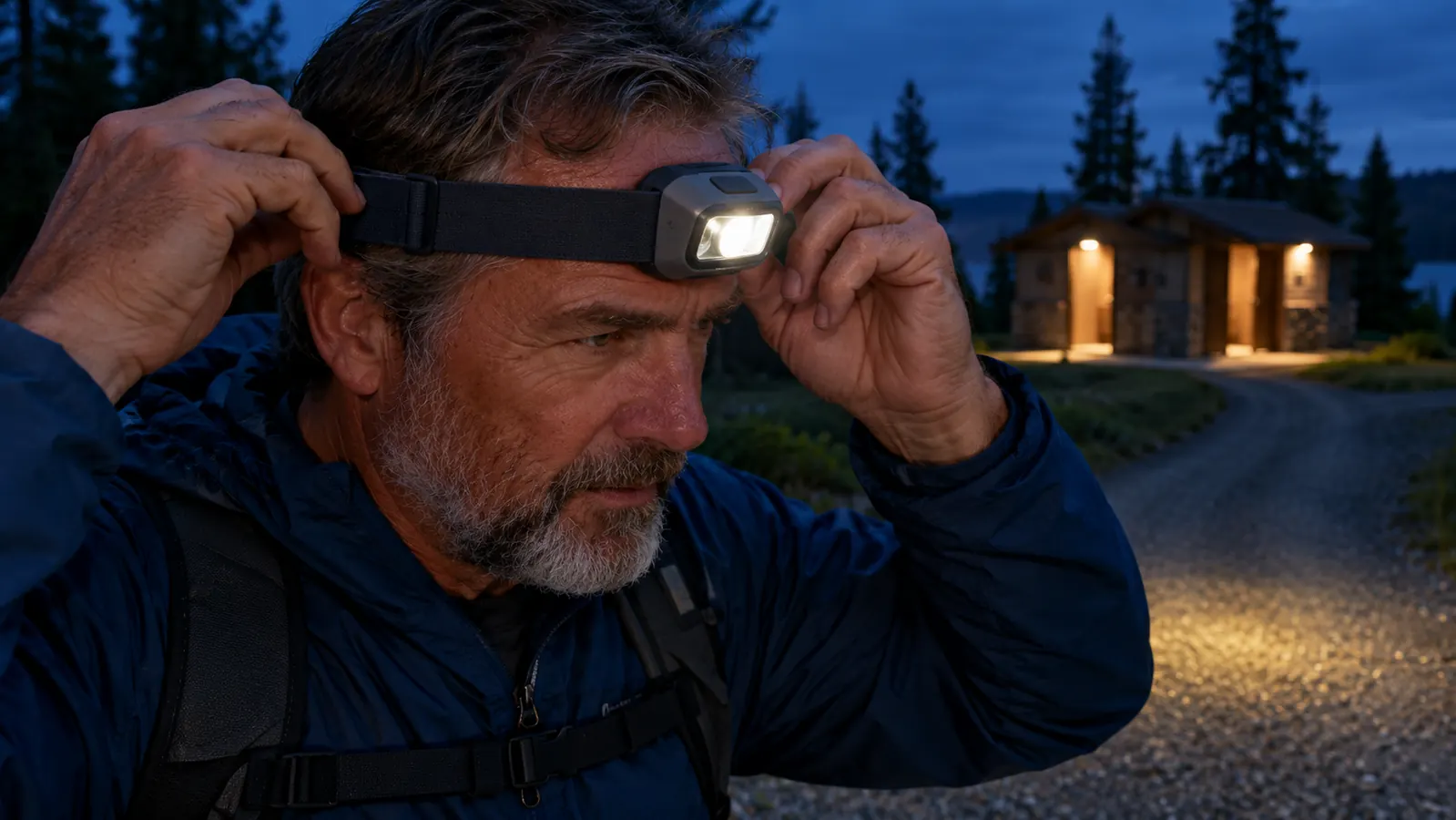
My use is narrow and I want to be honest about that up front, because a lot of headlamp reviews are written by people who run trails in the dark and that is not me. I do not hike at night. My day hikes run three to six miles and I am back at the car well before the light goes. The lamp's real job is camp after sunset: the walk to the bathhouse, cooking at the picnic table, digging through the back of the CR-V for a sweatshirt, and reading in the tent before I sleep. It also gets used on the short walk when Ray and I visit neighbors two sites over on the loop road.
That is a modest workload for a lamp rated at 400 lumens, and I think that is the point most reviews skip past. This is more light than a car camper actually needs. It is also not a specialist piece of equipment. It is the light you grab because it is hanging on the hook by the tent door and you already know it will work, and after eight months I can say that it has.
On batteries: I put in the three AAA cells that came in the box in March and I changed them once, in August. Roughly five months of weekend use on the included set, which surprised me in a good way. I keep a spare set in the glovebox now, not because the lamp let me down but because I do not want to find out the hard way on a night when the bathhouse is the only running water for a mile in either direction.
The lamp weighs 3.04 ounces and measures 1 inch deep by 1 inch wide by 2 inches tall according to the listing, which matches what my hand tells me when I pick it up. It disappears into the top pocket of my pack, and it does not pull at my forehead the way I expected a lamp with batteries in the front to pull. I forget I am wearing it. That is close to the highest compliment I can give a piece of head gear.
What Nobody Tells You About 400 Lumens
Nobody tells you that the top setting is the one you will use least. The listing says the Spot 400 delivers up to 400 lumens and offers multiple brightness settings and proximity modes, and that is accurate as far as it goes. What the listing does not say is that on a campground loop road, the highest setting is close to antisocial. Put a beam that strong through a neighbor's screen house at nine at night and you will make an impression you did not intend to make.
I use the lower settings almost exclusively. For the walk to the bathhouse, a middle setting is plenty to see gravel, tree roots, and the occasional puddle holding the day's rain. For close work at the picnic table there is a proximity mode that softens and spreads the light so it does not blow out everything within three feet of your face. Chopping an onion at a picnic table after dark with a full power beam is a genuinely miserable experience, and I did it once in March before I figured that out. On the softer setting it is just cooking.
The high setting earns its keep in exactly one situation for me, and it happens most weekends: something gets dropped. A tent stake, a bottle cap, a set of car keys, the tiny screw off the arm of my reading glasses. Full power turns a search of the dark ground under the picnic table into a ten second job instead of a ten minute one with a phone light and a bad attitude.
What all of that adds up to is a lamp that is versatile rather than simple. Some people want a headlamp with two settings and a switch, and I understand that. This one hands you a range and trusts you to pick from it. If you have never used a lamp with a proximity mode, the first evening will involve some fiddling. By the second weekend it is muscle memory, and you will wonder why you ever thought it was complicated.
The Red Mode Is the Reason It Stays on the Hook
The listing calls it a red night-vision mode. I call it the reason I do not get elbowed in the middle of the night. Ray goes to sleep before I do, and our tent is not enormous, and there is nothing quite like a white beam across the ceiling of a small tent to turn a sleeping husband into a wide awake and slightly irritated husband. The red setting is dim and narrow enough that I can find my boots, my water bottle, and the zipper without lighting up the whole inside of the tent.
It also saves my own night vision, which matters more than I expected. When I come back from the bathhouse at eleven and step off the gravel into grass, I can still see the tent outline and the cooler and the camp chair without turning everything into a bright white stage. I set the lamp to red before I leave the bathhouse door and I leave it there until I am zipped in.
Two honest caveats. The red mode is dim by design, and it is not much help in a campground you have never walked before, when you are trying to read a site number post at a distance. On a first night at an unfamiliar park I use a lower white setting for the walk and get my bearings, then switch over. And the lamp does not decide this for you. You have to remember to change the setting before you need it, because doing it in the dark with your hands full is the kind of small annoyance that becomes a running joke in a marriage.
The Batteries Are Where I Would Change Things
The Spot 400 runs on three AAA batteries, alkaline, included in the box. That is a fine decision for a lamp that lives in a car and comes out ten weekends a year, because AAA cells are sold at every gas station and country store between my house and the campground, and I have never once had to plan around charging anything.
Here is the part nobody mentions. When these batteries go, they do not fade politely. There is no slow dimming that warns you to swap them at your convenience. The last stretch of life is a quick drop from usable to useless, and it happened to me on a Saturday night in August on the far side of the loop road with a cold walk back to the tent. I changed them the next morning, sitting on the tailgate, and the whole job took two minutes. But I would rather have known.
The other thing I would change is the setup out of the box. Black Diamond builds the lamp so it can be upgraded to the rechargeable BD 1500 lithium ion battery and charger, which is sold separately. I have not bought that pack. I am still deciding whether I want it, and I want to be clear that I am describing the option from the listing, not from my own use. What I can tell you is that a lamp I use this often, on this predictable a schedule, is a lamp I would rather have bought in rechargeable form from the start. Three alkaline cells into a landfill every five months is not a catastrophe. It is just not what I would choose.
If you already own a pile of rechargeable AAA cells and a charger, none of this matters and you can ignore the last two paragraphs. That is a real advantage of the AAA design and I do not want to undersell it. A dead battery in this lamp is a five minute problem anywhere in the state of Alabama. A dead battery in a sealed rechargeable lamp is a problem that waits until you get home.

Waterproofing, Weight, and the Headband
The listing for the Black Diamond Spot 400 puts the water resistance level at waterproof, which is a strong word, so I paid attention. I wore it in the May rain walking the loop road to the bathhouse, and it kept working with no fogging, no flicker, and no water inside. I have not dunked it in a creek and I am not going to, because I like it and I do not need to prove anything. For a camper who gets caught out in weather, the rating has held up in my one season of use.
The headband is adjustable and it stays where I put it, including over a ball cap on a cool morning, which is more than I can say for the strap on my old binoculars. The housing sits flat against the forehead and does not rock when I look down at a skillet. Four hundred lumens bouncing around because a lamp is sliding on your head is a genuinely unpleasant way to cook bacon.
At 3.04 ounces it is light enough that I have finished a whole evening at camp and forgotten it was on until Ray asked why I was still wearing it. It also stores small. It lives in the glovebox of the CR-V between trips, next to the old handheld flashlight, and it takes up less room than the tire gauge.
What I Liked
- Red night-vision mode I use every single night at camp
- Waterproof rating that has held up through rain on the loop road
- Multiple brightness settings plus a proximity mode that makes close work usable
- Light enough at 3.04 ounces that I forget it is on my head
- Runs on three AAA batteries, included, and sold in every gas station I pass
- Adjustable headband stays put, even over a ball cap
Where It Falls Short
- Ships with alkaline AAA batteries rather than the rechargeable pack
- No real warning when the batteries are nearly finished
- The highest setting is more light than a campground ever needs
- The rechargeable BD 1500 battery and charger are sold separately
Four hundred lumens is more light than a car camper needs. The setting I reach for most is the one that puts out the least.
Who This Is For
This lamp suits a car camper who wants one light that does everything after dark and does not want to think about it again. If your evenings involve a bathhouse walk, a stove, a picnic table, and a tent, and you want both hands free, the Black Diamond Spot 400 covers all of that without asking you to learn anything complicated. It also suits the person who is finally tired of holding a flashlight in their teeth or setting a phone face down on a cooler and hoping.
It is a good fit for someone who camps in weather and wants a lamp rated waterproof rather than water resistant. And it is a reasonable choice for anyone who likes gear that runs on ordinary batteries, because there is real comfort in knowing a replacement is behind the counter at any store you pass on the drive home.
Who Should Skip It
Skip it if you are a night hiker, a trail runner, or a backpacker counting ounces. The weight is fine for a car camper and heavy for someone trimming grams, and the three AAA cells mean you are carrying spares rather than charging from a battery bank. Skip it if you want a lamp that is rechargeable straight out of the box with no separate purchase, because this one is not that lamp unless you buy the extra pack.
And skip it if you want a single button and a single level of light. This lamp gives you a range of brightness settings and proximity modes and a red mode, and it expects you to pick. I like that after eight months. Someone who wants to press one button in the dark and get a sensible beam has a fair argument too, and there is no shame in buying for that instead. A headlamp is a tool, not a personality, and the right one is the one you will actually wear.
Eight months, one battery change, and it is still on the hook by the tent door
If you want a camp lamp with a red mode you will genuinely use and a waterproof rating that holds, this is the one I would buy again. Price the rechargeable pack in from the start and you will skip my only real complaint.
Amazon Check Today's Price on Amazon →