
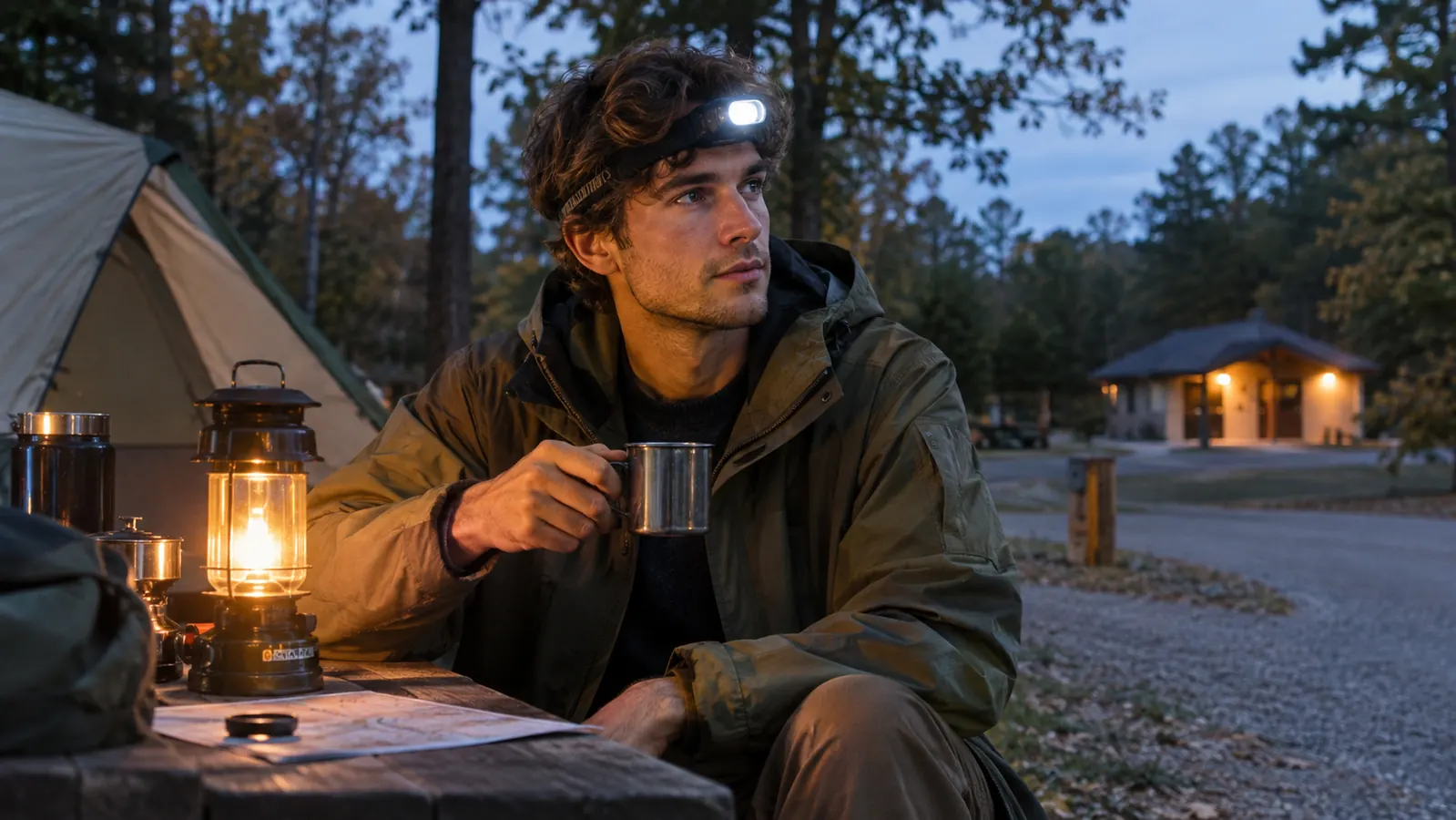
The walk from our usual campsite to the bathhouse is about 200 yards. Gravel loop road, one light pole halfway, a low spot where the drainage runs across. I have made that walk after dark more times than I can count in twenty-five years of camping, and I still do not do it by memory. My first season I carried a plain handheld flashlight and a shower bag at the same time, and I learned in about ten feet that one hand is not enough when the gravel rolls under your boot. Now I wear a headlamp. The Black Diamond Spot 400 is the one I bought the first week of March and have worn on that walk on every camping weekend since.
I am not going to dress this up as a backcountry epic. It is a state park campground in north Alabama with a bathhouse, a gravel loop, and a light pole that works most of the time. That is exactly why people get careless out there. You know the route, you are tired, your hands are full, and the next thing you know your foot slides on loose gravel and your towel is in the ditch. Here are the five steps I actually follow, in the order I follow them.
The light I strap on before I ever step off the site
Black Diamond Spot 400. 400 lumens, red night mode, three AAA batteries included, waterproof, and 3.04 ounces on your head. It has been my only headlamp for one full season, March through October.
Amazon Check Today's Price on Amazon →Step 1: Get Everything Into One Bag Before the Light Goes On
Stand at the picnic table and get everything into one bag before the light goes on your head. For me that is a shower bag, my glasses case, and the site keys. Ray carries his own towel and his own light and has never once needed me to hold something of his on that road. The point is not to travel light for the sake of it. Every extra item is one more thing to drop in the gravel at ten at night, and one more reason to have a hand full when you need it on a door frame or a handrail.
This is the reason I stopped using the handheld flashlight as my main light. A flashlight does one job and takes one hand to do it. A headlamp does the same job and leaves both hands free. The Spot 400 weighs 3.04 ounces, which you will notice for the first minute and then forget, and the adjustable headband holds it steady enough that the beam does not bounce when you walk. If you are the person carrying a mug, a phone, and a map to the bathhouse, a headlamp is the only light that lets you do all three.
One more thing about those 200 yards. The road is flat enough to fool you into walking fast, and the gravel is the kind that shifts under a boot. I have watched a man try to carry a folding chair, a cooler, and a flashlight down that same stretch. He made it, and he also stopped three times to set something down. I would rather carry less and walk slower. Whatever you decide to bring, decide it at the table, not halfway down the road with your arms full.
Step 2: Put It On and Test It While You Are Still at the Site
I put the headlamp on while I am still standing under the lantern at the site, not out on the road. The strap goes on, I click through the settings once, and I check that the red mode comes on. If a battery is turned around or the strap has worked loose in the bottom of my bag, I want to find that out next to my own cooler instead of in the middle of the loop road with a shower bag in my hand.
The Black Diamond Spot 400 runs on three AAA batteries, and they come in the box. I have changed mine once, in August, when the red mode started looking dim on the walk back. That is the entire battery record for the season. I do not carry a spare set on the walk itself. There is a spare pack in the glovebox of the CR-V, and I would rather walk back to the car than stand in the gravel swapping batteries after dark. If you use the light around the house between trips, check it before you load the car, not after.
The strap is worth a minute of your attention. My head is not the same size as Ray's, and the adjustable headband means either of us can get it snug without it pressing into the forehead. A loose headlamp bounces with every step, and a bouncing beam makes the ground look like it is moving under you. Snug it down once, then leave it alone for the walk.
Step 3: Point the Beam at the Ground, Not at the Trees
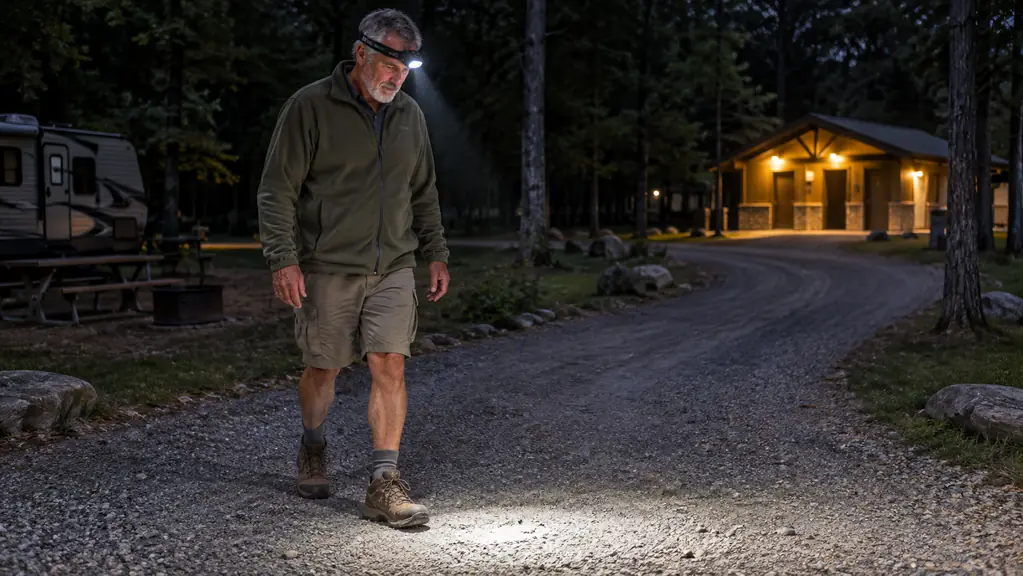
The Spot 400 puts out up to 400 lumens, and it has multiple brightness settings and proximity modes. I do not walk the loop road on the brightest setting. I set it low, pointed at the gravel six or eight feet in front of me, and I leave it there. Full power is for the moment I need to see whether the bathhouse door is propped open or whether somebody is standing at the far end of the building. For walking, a dim wide beam on the ground beats a bright narrow one pointed at the trees every single time.
That is the part people get wrong with any headlamp, not just this one. They turn it to the brightest setting, aim it straight ahead, and then cannot see the loose gravel because the light is landing twenty feet out. Point it down. Walk into the light instead of behind it. The proximity modes are useful for close work at the bathhouse door and for the padlock on the site box, and I use them there instead of blinding myself against a painted wall.
If a car comes around the loop, I turn the light down and step onto the grass until it passes. A headlamp on full power in a driver's eyes is not helpful to anybody. Same goes for other campers. I keep the beam on the ground between me and the next site, not sweeping across their picnic table while they are trying to eat.
Step 4: Walk the Route You Walked in Daylight
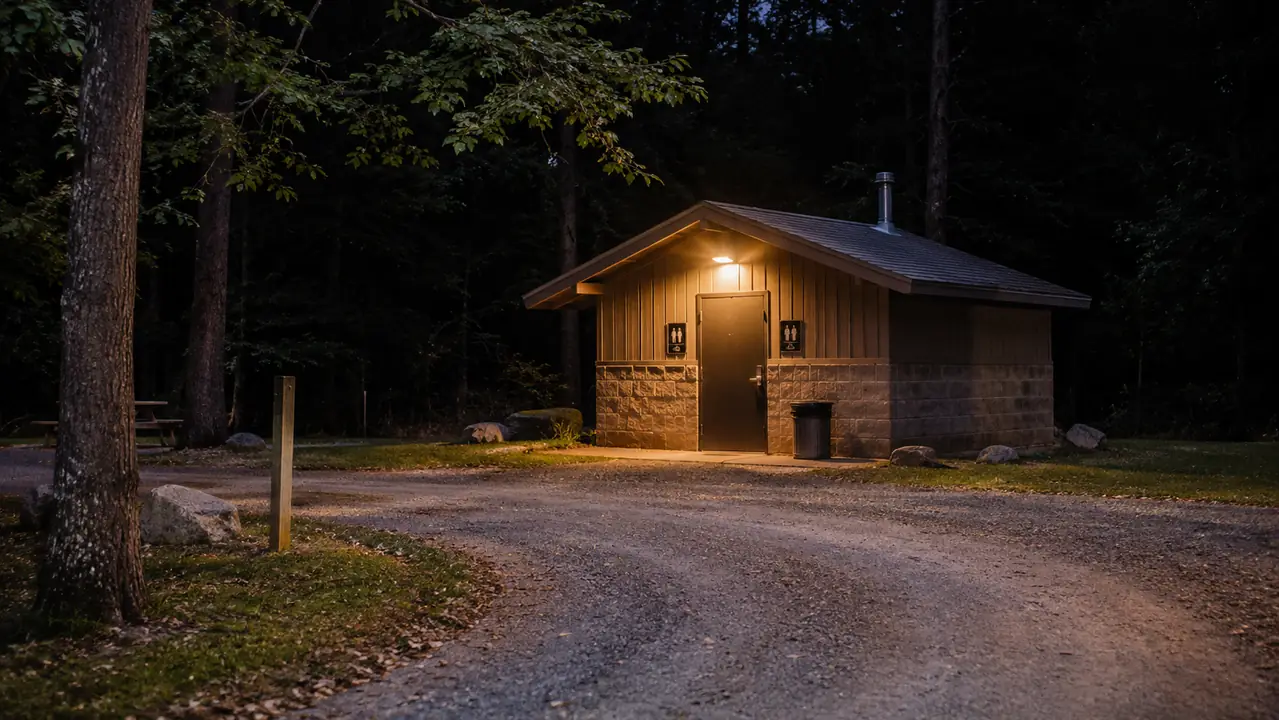
I walk the gravel loop road, the same way I came in, even when cutting between two sites would save me forty yards. The shortcuts are where the guy lines, the picnic table corners, and the cooler lids live. In daylight you see all of it. After dark you see whatever your beam happens to be pointed at, and that is not the same thing. The road is boring. Take the boring one.
If I am at a campground I have not stayed at before, I walk the route to the bathhouse once in the afternoon, before dinner. I look for the low spot, the speed bump, the place where the gravel thins out to dirt, and the door I will actually be using. Then after dark I am not exploring. I am repeating. That five minute walk in daylight has saved me more trouble than any piece of gear I own.
Ray usually walks up ahead of me and I keep my beam on the ground between us instead of in his eyes. We have done that road enough times that neither of us talks much on it. The one time I broke the routine, I cut across an empty site to save time and put my shin into a picnic table bench. I have not done it since.
Step 5: Reset Everything When You Get Back
Back at the site, I switch to the red mode before I unzip the tent. The red night-vision mode is easier on my eyes, and more to the point it does not wake Ray if he has already turned in. I hang the headlamp on the loop at the top of the tent door with the strap open so it can dry if it has been raining, and I leave it there until morning. The red mode is also what I use if I get up before daylight to start the stove.
In the morning I check the strap and the lens, wipe off any grit, and put it back in the gear bag. Once a season I swap in fresh batteries, which for me was the one change in August. That is the whole maintenance routine. The Spot 400 has been out in rain on that walk and kept working, and the listing rates it waterproof, which matches what I have seen. I would not swim with it. I have also never needed to swim to the bathhouse.
What Else Helps
A second light in the car is worth more than a second light on your head. My old handheld flashlight lives in the glovebox of the CR-V and comes out maybe twice a season, usually when I have left the headlamp on the kitchen counter at home. I also keep a spare three pack of AAA batteries in the console. That is not gear obsession. It is the same reason I keep a spare house key: the night I need it, I will not want to drive to town for it.
Telling Ray where I am going and roughly how long it takes helps, even though the answer never changes. Two hundred yards, ten minutes, back before the coffee goes cold. It is not about danger. A person walking a dark road with a light on their head is easy to miss if somebody is looking in the wrong direction, and it costs nothing to say it out loud.
A small lantern at the picnic table is the other thing that helps, and it has nothing to do with the walk itself. If the table is lit when you come back, you can find your mug and your chair without putting a beam in anybody's face. I set ours out before I leave and turn it off when I turn in. Small habit, less fumbling.
Three AAA batteries, changed once in August, carried me through every bathhouse walk from March to October. That is the whole battery record for the season.
What a Headlamp Will Not Do
It will not make an unfamiliar campground safe. It will not fix a road with a washed out edge or a bathhouse with a burned out bulb over the door. It will not keep you upright if you are walking fast and looking at your phone. What it does is put a steady beam where your feet are going and leave both hands for the things that need them. That is a smaller promise than most gear writing makes, and it is the one I can stand behind after one season.
If your camping involves a trail in the dark, a route you have never walked, or country with no bathhouse and no loop road, this article is not for you. I do not hike at night and I do not pretend to. The Spot 400 is the light I wear for the bathhouse walk, for cooking after dark at the stove, and for finding my boots at five in the morning. That is the job. It does the job.
One small change that makes 200 yards a lot less interesting
Black Diamond Spot 400. 400 lumens, red night mode, three AAA batteries included, adjustable headband, 3.04 ounces. The same light I have worn on every bathhouse walk since March.
Amazon Check Today's Price on Amazon →