

I bought the Therm-a-Rest Z Lite Sol in the first week of March, the same week I carried an air mattress out to the curb. That mattress had gone soft on me four camping trips running. The fourth time I woke up at two in the morning with my hip on the tent floor, I decided I was finished inflating things in the dark.
Here is the honest version up front. The Therm-a-Rest Z Lite Sol is a good pad and it has been under me on every camping weekend since. It is also three-quarters of an inch of closed-cell foam, and no amount of clever engineering changes what three-quarters of an inch feels like over a root. Most reviews give you one of those two facts. You need both, because which one matters more depends entirely on the kind of sleeper you are.
I am 57, I live outside Fort Payne, Alabama, and I camp about ten two-night weekends a season at state park campgrounds. There is a bathhouse. There is a gravel loop road. There is no backpacking, no ridgeline, no counting ounces on a scale. I am a retired dental hygienist with a stiff lower back in the mornings, and the only expertise I am bringing to this is eight months of sleeping on the thing.
So here is what I like, what I would change, and who should walk right past it.
The Quick Verdict
Nothing to inflate, nothing to fail, and a firm surface that ended my midnight deflation problem for good. It is thin, it does not pack down small, and it will not fix an uneven site.
Amazon Check Today's Price →The pad that cannot go flat at two in the morning
Closed-cell foam, 14 ounces, folds to 20 by 5 by 5.5 inches. No valve, no pump, nothing to repair in the dark.
Amazon Check Today's Price on Amazon →How I've Used It
One pad. Bought new, my own money. It has been on the floor of the tent from March through October, which came to about ten camping weekends. I sleep on it. Ray sleeps on his own pad beside me and has never once asked to trade.
I want to be clear that I am not the camper this pad is marketed hardest at. Backpackers buy it because 14 ounces is nothing on a long carry. I bought it because the CR-V has room and I wanted something that could not go flat. It turns out the same set of properties serves both of us, for completely different reasons, and I suspect that is true of most people who end up owning one.
The first two weekends were the real test, because that is when you find out whether a change was actually a change. My old mattress had gotten to where it went soft around midnight, so I was used to waking up, rolling over, and finding the floor. On the foam pad I noticed by the second weekend that I was getting out of the sleeping bag less carefully. Not cured. Not fixed. Just less of that first-step wince on the walk to the bathhouse.
That is the whole claim I am making and I am not going to stretch it into more. Foam does not go flat. When you have spent a season waking up on a deflated mattress, that one property is worth more than every line on the product page.
Ray's review, offered unprompted on the first night, was to ask whether I had forgotten to inflate it. I have thought about that a lot since. It is the most honest summary of this pad I could give you, and it came from a man who was not trying to be helpful.
What Nobody Tells You Before You Buy Foam
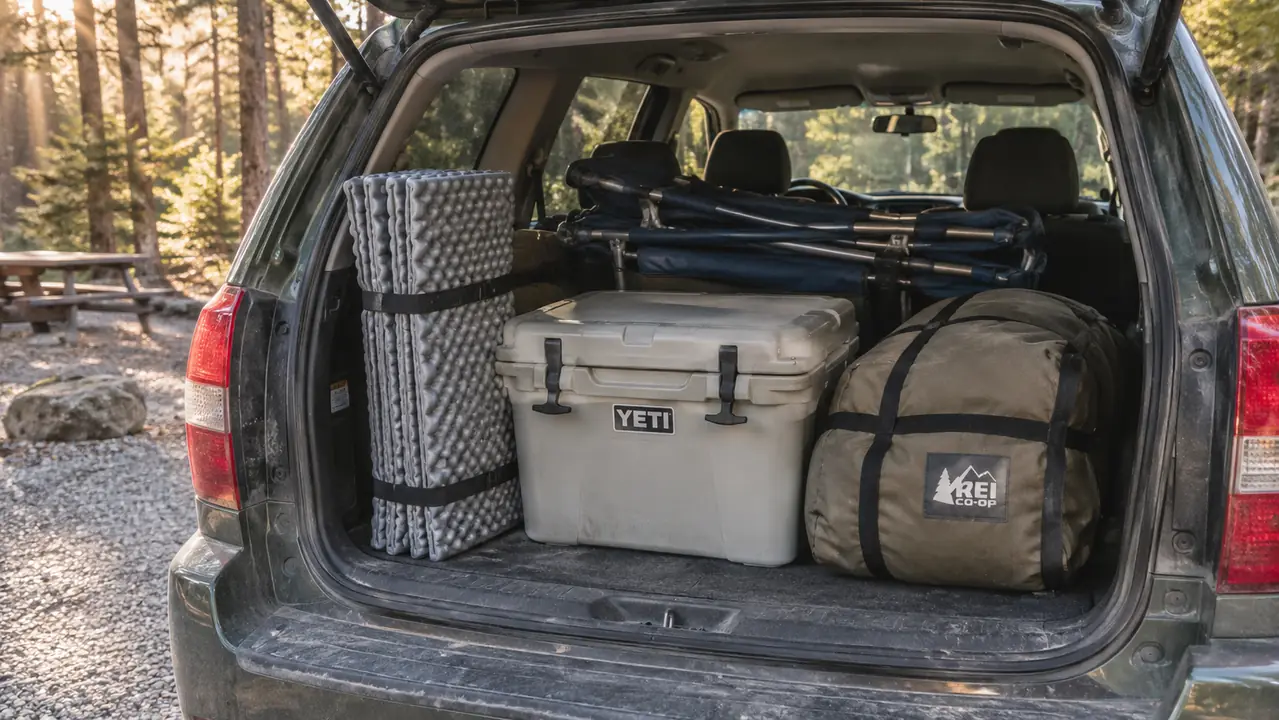
The listing leads with weight and packability and those numbers are real. Fourteen ounces, which is nothing. It folds down to 20 by 5 by 5.5 inches, small enough to live in the back of the CR-V without me thinking about it.
The number that actually decides your night is 0.75 inches. Seventy-two inches long, twenty inches wide, three-quarters of an inch thick. That is the entire product. There is no valve to fail, no baffle to leak, no pump to leave on the kitchen counter. There is also no way to soften the thing up when the ground under your tent turns out to be a root.
The trade is the whole purchase. You give up cushioning and adjustability. You get a surface that is the same firmness on night ten as it was on night one, and that cannot quietly betray you while you sleep. Which side of that trade you land on depends on which failure has burned you worse. I have been burned by a slow leak, so I know my answer.
One more thing nobody leads with: Therm-a-Rest makes this pad in the USA, and the material is listed as ThermaCapture with a water resistant finish. The water resistance matters more than you would think. On a damp morning the surface beads up, and I wipe it with a bandana before I fold it. It is not waterproof. Do not treat it like a raft.
Fourteen ounces, no valve, no pump, and no way to wake up on the ground. That is the trade, and for me it was a fair one.
The Thickness Question, Which Is Really the Whole Question
Three-quarters of an inch. I keep coming back to it, and it is the number buried in the dimensions line rather than in the headline. It is not a flaw in the design. It is the design. A pad that folds to 20 by 5 by 5.5 inches and weighs 14 ounces gets there by not being thick.
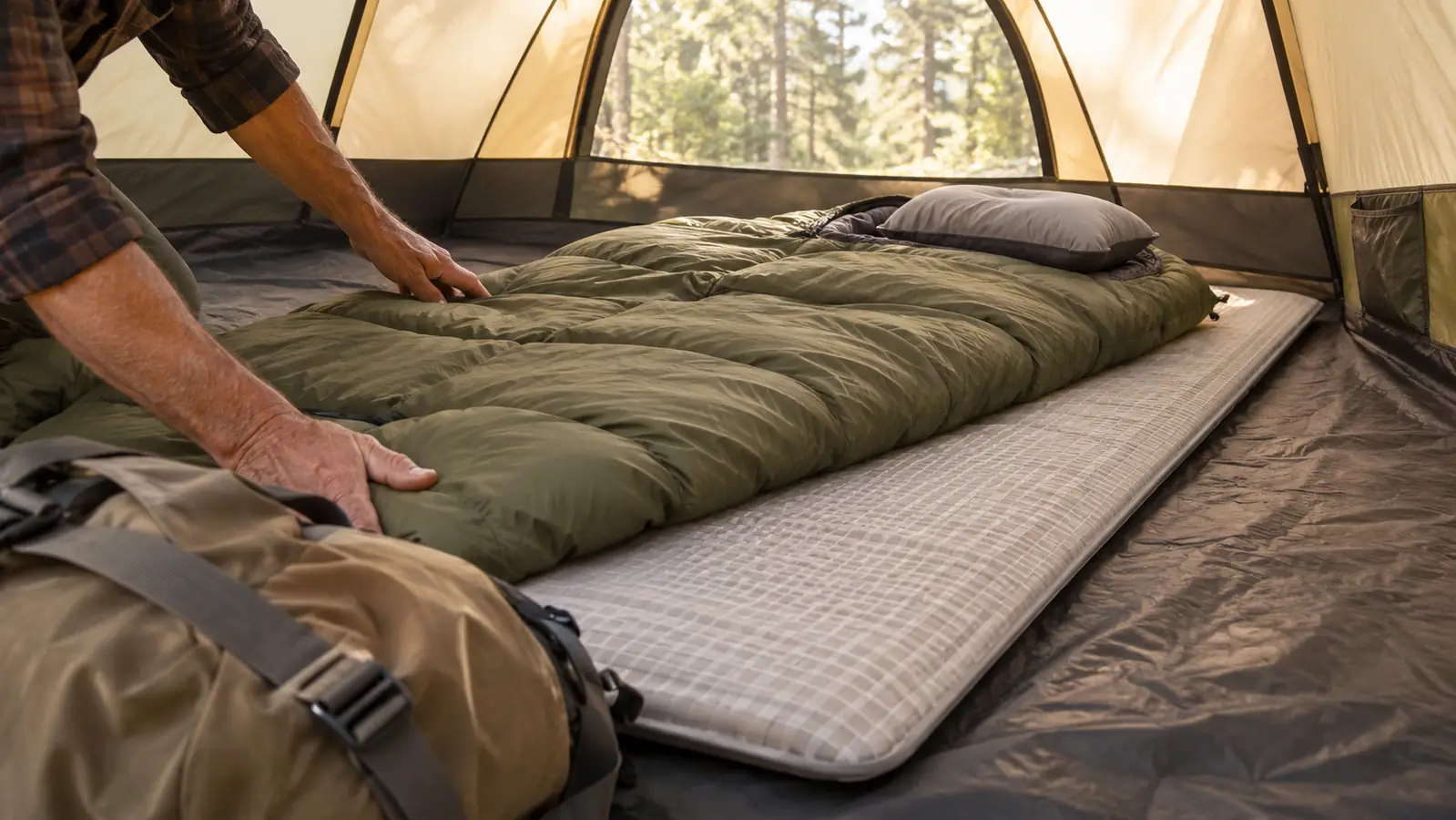
In practice, on a smooth and level tent pad, I cannot tell the difference between this and the air mattress I retired. On a site where the ground is uneven, or where a root runs under the floor, I can feel it. Not painfully. I just know it is there. My first weekend at a site with a root, I spent twenty minutes dragging the tent six inches to the left, and after that I never thought about it again.
So the honest framing is this: the pad does not fix the ground. It just does not fail you on top of it. If you are willing to pick your spot and clear it, three-quarters of an inch is plenty. If you want the ground itself to stop mattering, you need something thicker and the upkeep that comes with it.
It is also the reason this pad does not need a patch kit. There is no chamber to puncture. A sharp stick under the tent floor can put a hole in an air chamber. On closed-cell foam it leaves a mark and nothing else. That is the whole difference, and it is the difference that matters to me at this stage of my camping life.
The Warmth Claim, Answered Honestly
The listing says the reflective coating and the heat-trapping dimples capture radiant heat and add about 20 percent warmth. I cannot verify a percentage from inside a sleeping bag and I am not going to pretend I can. What I can tell you is that on the cool nights at the front and back of the season, I did not feel cold coming up through the pad. The one night I was cold, it was my quilt's fault, and I have since fixed that.
What I would not do is carry this into real cold and expect the reflective layer to cover for everything above it. It is a barrier between you and the ground with a heat-reflecting surface on it. That is a real thing. It is also not a furnace, and the foam underneath is still foam.
Setup, Teardown, and Folding It Tidy
There is no setup. You unfold it. When you pull into a site at dusk and Ray is already asking where the lantern went, that matters more than any spec sheet can say. Unfold, lay the bag on top, done. Teardown is the reverse and takes about the same effort, which is to say almost none.
There is one habit worth building. I unfold it the moment the tent is up, even if I am not going to bed for hours. Not because the foam needs anything from me, but because by the time I am tired and the light is gone, I want that one job already finished and the pad waiting where I can find it by feel.
Folding it back neat takes practice. You are taking a 72 inch pad down to 20 by 5 by 5.5 inches, and if you hurry it the ends do not line up and it goes into the car crooked. It took me a few weekends to get good at it. Not hard, just not instant. On a wet morning I wipe the surface down first, because water resistant is not the same as waterproof and I would rather not pack it away damp.
What I Liked
- Nothing to inflate, so there is no midnight deflation and nothing to repair in the dark
- Folds to 20 by 5 by 5.5 inches and weighs 14 ounces, so it disappears into the back of the car
- Closed-cell foam cannot go flat, which is the exact failure that retired my air mattress
- Same firmness on night ten as on night one, with no adjustment to drift
- Water resistant surface wipes dry with a bandana on a damp morning
- The reflective ThermaCapture coating and heat-trapping dimples are listed as adding about 20 percent warmth, and I did not feel cold coming up through it in spring or late fall
Where It Falls Short
- 0.75 inches is 0.75 inches, and a root under the tent floor still finds you
- One firmness, no adjustment, and no way to soften it up on a bad night
- It does not compress, so folded it takes up real room next to the cooler
- The dimples are noticeable through a thin summer bag
- Side sleeping is not comfortable, at least not for my hip
What I Would Change
The first thing is the thickness. Not because 0.75 inches is wrong, but because there is no version of this pad for someone who wants the same no-fail surface with a little more between them and the ground. You are either in on thin foam or you are shopping somewhere else. I would pay for a half inch more under my hip and I suspect a lot of other people would too.
Second, the packed size. Folded it is 20 by 5 by 5.5 inches and that is as small as it will ever be. It does not compress further. On a longer weekend with the tent, the stove, and the cooler in the back of the CR-V, this is the item I have to think about where to put. An air pad with similar comfort would take less room. It would also be an air pad, and I have made my peace with that.
Third, the dimples. They are the mechanism that traps heat, so I understand why they are there, but through a thin summer bag I can feel them. I stopped noticing after a few nights. I would still rather have a smooth top and give back a little of the warmth, and I suspect I am not the only one.
Fourth, and this is small, the fold lines. Eight months of folding has left soft creases, and when I unfold it I run a hand along the whole length before the bag goes down. Ten seconds. It registers as a chore on a rainy evening, when everything already takes longer than it should.
After Eight Months, What Has Held Up
Eight months, about ten weekends, one pad. The dimples are still dimples. The reflective surface has not flaked or worn through at the heels and shoulders, which was the thing I worried about most. The foam has not gone soft and has not taken a permanent set along the fold lines. It looks like what it is, a piece of foam that gets unfolded and folded again, and it still does the job it did in March.
Therm-a-Rest lists the warranty as limited. I have not had to test it, and the only useful thing I can tell you about a warranty you have not used is that you have not used it. Between trips the pad stays folded in the garage. I have not babied it. I have also not left it out in the sun for a week or dragged it across gravel, so weigh that accordingly.
The One Question That Decides It
If I had to reduce eight months to a single question, it would be this: which failure can you live with? An air pad fails by going flat, usually at the worst hour, and it fails suddenly. A foam pad fails by being thin, quietly, every night, in exactly the same way. One is a surprise and one is a constant.
I found the surprise worse. I can plan around thin. I can walk the site, move the tent, and put my bag where the ground is level. I cannot plan around a mattress deciding at midnight that it is done. That is the reason this pad is still in my car and the other one is at the curb.
Who This Is For
Car campers and weekend campers who are tired of air mattresses going soft, and who would rather carry something simple than maintain something complicated. Back and stomach sleepers who do not need deep cushioning. Anyone who has woken up at two in the morning on the tent floor and said never again.
The Therm-a-Rest Z Lite Sol is also a good second pad, because there is nothing to teach. You hand a guest a folded piece of foam and they know exactly what to do with it. There is no valve to explain and no pump to lose. My husband figured that out on his own without instruction, which is the highest praise I can give a piece of camping gear.
One practical note on size: 72 inches long and 20 wide is a full-length pad, so a taller camper is covered and a shorter one has room to spare. I am not tall and I use every inch of it, because I sprawl once I am asleep.
Who Should Skip It
Side sleepers, especially side sleepers with hip or shoulder trouble. I tried sleeping on my side the first few nights and my hip had opinions about it. I went back to my back and stayed there. If you need cushion, three-quarters of an inch is not going to give it to you, and I would not tell you otherwise to make a sale.
Also skip it if you need a small packed size, if you camp in genuine cold and expect the pad to do the heavy lifting, or if you want to firm up or soften your bed depending on the night. This pad has one setting. It is a good setting. It is not adjustable, and it is not going to become adjustable.
If none of that describes you, the Therm-a-Rest Z Lite Sol is a plain answer to a problem that does not need to be complicated. Eight months in, that is exactly what it has been for me: the one piece of sleep gear I never think about, which after a season of midnight deflations is a strange thing to be grateful for.
Eight months in, and nothing has leaked, because there is nothing to leak
If a slow deflation is what retired your last pad, closed-cell foam solves that problem permanently. One unfold and you are done.
Amazon Check Today's Price on Amazon →